:::alpha:::
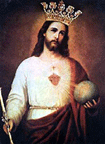
:::Banner of the Sacre-Coeur
of our Brother: King
of these Kings in his Kingdom
on his Earth in his Heavens,
as our Judge & Redeemer:::
|
:::Our Father,
who art in Heaven,
Holy be thy name:
Thy Kingdom Come:::
:Bible:
|
:::sophia:::

:::Stamp against all evil
by our Virgin-Mother: Queen,
Coredemptrix and
Mediatrix of all Graces,
as our Counselor & Advocate::: |
:Bible: Book of the Law:
:There are many bibles, as Bible means book.
Old Testament: The first part of the bible is
a collection of pre-Christian writings the Church claims carry the inspiration
of the Holy Ghost.
New Testament: Writings claimed by the Church
as inspired writings of the Apostles.
Versions of His-Story:
The Greek Septuagint first appears in about 148
B.C. and was used by the Apostles.
The Latin Vulgate appears in 404 A.D. translated
as a careful, word-for-word rendering of the original Greek and Hebrew texts
into the common-tongue: Latin by Saint-Jerome (342-420), one of the four great
Western Fathers of the Church. Saint-Jerome knew Latin and Greek perfectly.
Saint-Jerome was 1500 years closer to the original languages than any scholar
today, which gives him greater knowledge of the exact meanings of the Greek
and Hebrew words in the Scriptures. Saint-Jerome is a linguistic genius with
first-person knowledge of what is to us ancient Latin and Greek. He is a great
saint with access to Hebrew and Greek manuscripts of the 2nd and 3rd centuries,
since lost to all scholars.
The Latin Vulgate is the most important translation because it
is done meticulously by a saint at a time close to the time of the writing of
the original, so Greek meanings have not changed as much as they have today,
since Greek is a living language. Since Latin after this time is primarily a
spiritual language, there is little change of cultural usage or meaning since
then in the Latin. The Latin Vulgate is the most universal Bible of the Latin
Rite, the largest rite of the Universal Church.
The Council of Trent claims the Vulgate as the official Latin
version of the original: "Moreover, the same Holy Council . . . ordains
and declares that the old Latin Vulgate Edition, which, in use for so many hundred
years, has been approved by the Church, be in public lectures, disputatious,
sermons and expositions held as authentic, and so no one dare
or presume under any pretext whatsoever to reject it." (Fourth Session,
April 8, 1546). Pope Pius XII states in the 1943 encyclical letter Divino Afflante
Spiritu, this means the Vulgate is "free from any error whatsoever in matters
of faith and morals."
Douay-Rheims appears in 1592-1609, predating
any Protestant Bible by at least 2 years. It is a scrupulously faithful translation
of the Latin Vulgate into English. The Douay-Rheims bible is a faithful, word-for-word
translation of the Latin Vulgate Bible of St. Jerome.
When a passage seems strange or obscure, Modern translators write what they
think true scripture means, substituting words and altering phrasing. The result
is often easier to understand, but one is understanding an interpretation, not
the authentic communication. The infinite layers of meaning seal in the original
word-meanings and syntax-structure by teh Holy Ghost are often lost.
Is it best to translate into our common-tongue: English from the
Latin Vulgate, or the original Greek and Hebrew? This was asked in the 16th
century when Father Gregory Martin and his assistants began
translating the scriptures and first published the Rheims New Testament. They
give ten reasons, the final one being that the Latin Vulgate "is
not only better then all other Latin translations, but then the Greek text itself,
in those places where they disagree." (Preface to the Rheims New
Testament, 1582). They claim the Vulgate is "more pure then the
Hebrew or Greek now extant" and that "the same Latin hath bene farre
better conserved from corruption." (Preface to the Douay Old Testament,
1609).
For a sample of the writing in the original: Douay-Rheims is:
Ephesians 6:12: "For our wrestling is not
against flesh and bloud: but against Princes and Potestats,
against the rectors of the world of this dankness, against the spirituals of
wickedness in the celestials." I have italicized the phrases
which modify nouns into a verb fiction. They are the phrases associated with
un-truth. God is with all of the nouns of the sentence with the use as the nouns.
Separate the wheat from the chaff, and we see two complete ideas interwoven
in one truthful communication:
"For our wrestling is against the rectors of the
world of this dankness, against the spirituals in the celestials; not against
flesh and bloud: but against Princes and Potestats of wickedness."
The current revision (1749-1752) of Douay-Rheims is actually by
a Bishop: Dr. Richard Challoner (1691-1781). Challoner is a
priest who travels around England during the religious persecutions, offering
Mass secretly for small groups. The Douay-Rheims Bible is in print on the Continent
but is hard to smuggle into England. Some Catholics in England are even reading
the chopped King James version for lack of Universal bibles. Bishop Challoner
modernizes archaic spellings, sets off verses on new lines for clarity, replaces
anglicized Latin words, archaic words, and expressions, rearranges word order,
while maintaining the overall word-for-word accuracy of the Douay-Rheims Bible,
checking against the Clementine Vulgate and the original-language texts.
The Challoner revision is the standard Catholic Bible in English until the Confraternity
Bible of the mid-20th century. The name "Douay-Rheims" continues because
of similarity to the original Douay-Rheims Bible. English Versions of the Bible,
by Fathers Pope and Bullough, states that Dr. Challoner provides for the first
time in history a portable, cheap and readable version of the Bible. The Challoner
revision is more accurate than any modern Bible because it is based on ancient
texts, no longer extant. The Douay-Rheims is the most reliable English-language
Bible.
The King James Version of the protestant bible
appears in 1611 A.D. and removes a number of books from the original.
The Preface of the New King James Version (NKJV) states, ".
. .thee, thou, and ye are replaced by the simple you,. . .These pronouns are
no longer part of our language." But "thee, thou and ye" were
no longer part of the language in 1611. Webster's Third New International Dictionary
says of ye: "used from the earliest of times to the late 13th century.
. ." (p.2648) The Greek and Hebrew contain a different word for the second
person singular and the second person plural pronouns. Today we use the word
"you" for both the singular and plural. Because the translators of
the 1611 King James Bible desired an accurate, word-for-word translation of
the Hebrew and Greek text - they could not use the word "you" throughout.
If it begins with "t" (thou, thy, thine) it's singular, but if it
begins with "y" (ye) it's PLURAL. The NKJV claims to make the "old"
KJV "much clearer" by "updating obsolete words" (New King
James Version, 1982e. p. 1235). For example, it updates and clarifies hell to
Hades and Sheol. Ezra 8:36: clarifies and updates, "And they delivered
the king's commissions unto the king's lieutenants. . ." to"And they
delivered the king's orders to the king's satraps. . ." Matthew 7:14: clarifies
"narrow is the way" to "difficult
is the way" even though Jesus says in Matt. 11:30, "For my yoke is
easy, and my burden is light." So clear! 2 Cor. 2:17:
changes "For we not as many which corrupt the word of
God" to "For we are not, as so many, peddling the
word of God" (as do the NIV, NASV, NRSV, and RSV versions). With so many
corruptions being peddled in these counterfeit bibles, it is no wonder this
clarification was needed... The NKJV removes the word "Lord" 66 times,
the word God 51 times and the word "heaven" 50 times!
"Not one jot or tittle of the law"
Greek-Septuagint
Greek-Septuagint
Douay-Rheims
& Latin-Vulgate
Douay-Rheims
& Concordance
Rheims: New-Testament:
Search
Religious-Library
Bible-Search
Bible-Links
:Claim of the Maxim: "_"
with the meaning: "_" is with the claim of the origin by
the century: ~_, Anno-Domini: author: _.
:Claim of the Etymology: For the word: _ is with the claim:
"_" with the ONLINE
ETYMOLOGY DICTIONARY by the Douglas: Harper. :Search.
:Claim of the Meaning with the English-language: For the term:
_
is with the claim: "_" with the Noah
Webster's 1828 American Dictionary of the English Language by the Noah:
Webster. :Search.
:Claim of the Meaning with the Law: For the term: _ is with
the claim: "_" with the Bouvier's
Law Dictionary, 1856 Edition (:Edition~1: 1839) by the John: Bouvier.
:Search.
:Claim of the Meaning with the Law: For the term: _ is with
the claim: "_" with the Douay-Rheims
Bible (:Challoner-version) by the Church. :Selection
of a Book :Search
of the Text.
:Claim of the Font: Italic: For
the use of the italic-font is with the common-tongue of the verb-fiction. For
a sample of this use is with the documentation for a quotation of a communication
with the writing or speaking by its author. For another sample of the use is
for the identification of the name of an fiction-entity.
:Claim of the Font: Bold: For
the use of the bold-font is for the emphasis with a matter for the benefit of
the ease of the identification and comprehension of the concepts of the document.
:Claim of the Font: Line: For
the use of the font with a line at the base of the letters is for the web-link
with the source for the confirmation of the matter, or with a page for the study
of a concept of the document.
:Claim of the Punctuation: Colon: For
the use of full colons is for the meaning as a phrase for the security of the
next-word:: meaning word with the nexus, as a noun.
:Claim of the Punctuation: Quotation: For
the use of the pairs of the opening and closing: quotation-marks is for the
meaning as the quotation of a communication by another party.
:Claim of the Punctuation: Box: For
the use of the pairs of the opening and closing: brackets, or parentheses is
for the lack of the joinder with the communication of the body of the document
by the law of the box. For the use of the box against the document is with the
meaning as a private-note for the edification of the reader by the author. For
the use of the box against a quotation is for the claims of the clarification
of the meaning of the quotation.
Links: Law;
Home
::CLAIM FOR HIS KINGDOM OF HIS HEAVEN
WITH THIS AMBASSADOR BY THE CHRIST::
For the sharing of these communications is for the spiritual-education,
healing-benefit and sanctification of each living-soul as a private-communion
with this minister, with the lack of any offer with the fiction-commerce of
this world and with the lack of any negotiability between all parties as these
cells in the Christ. For all truth and reality of all creation is with the ownership
by the Creator. For all matters in the universe of each moment are as the gift
for each soul with his love by our Lord. For any truth of these matters of this
page and site for the study is for the knowledge and freedom of the soul, with
the use with all love, charity, humility, honesty, wisdom and volition for the
good of all souls of our friends and enemies, foreign and domestic, as a gift
with the finding by the grace and will of our Lord. For all communications through
this Ambassador of the Christ are by this Glen-Martin of the Swartwout-family©-commonlaw-trade-name/copyright/COPYCLAIM/copy-Christ
with the claim of all powers for all truth in one law, with these claims with
the law by our Lord:
~I: U.C.C.: §: ~I: ~CIII (UCC 103)
with the correction of the language for the claims of the T.D.C.
with the correction of the language for the claim of the Threat, Duress and
Coersion by the Powers of this world against the will of our Lord; (Non
A)ssumsit-Contract with the correction
of the language for the lack of any authorization of any contract with the lack
of full closure with the claim of the meaning of each word in the truth with
the will by our Lord; and with the claim of the re:course for
the freedom against the compelling of any benefit and against any claim of an
occult-contract or claim of the commerce with any ficition; and with the claim
of all re:course by our Lord.
~II: U.C.C.: §: ~I: ~CIII: ~VI (UCC 103.6) with
the correction of the language for the claim of the common-Law
of this Christendom of the sojourners of this Earth in the Kingdom of the Heaven
with the creation and ownership by the Lord.
~III: U.C.C.: §: ~I: ~CCVII (UCC 207) with the
correction of the language for the claim of the re:medy for
the freedom of the contract against any force by the Powers of this world; with
the claim of the volition against any contract of a debt-discharge with any
association with the bankruptcy-scrip of the unity-States or with any fiction
or fraud with the conveyance of any value; and with the claim of all re:medy
by our Lord.
~IV: U.C.C.: §: ~I: ~CCVII: ~IV (UCC 207.4)
With(out) the (Pre)judice with the
correction of the language for the claim of the lack of any judgement of any
Man by another Man; and with the claim of the judgement by our Lord.
~V: U.C.C.: §: ~I: ~CCVII: ~VII (UCC 207.7)with
All Rights: (Re)serve(d) with the correction
of the language for the claim of all rights, freedoms and powers by the will
of our Lord.with the correction of the language for the claim against the waiver
of any powers with the gift by our Lord.
~VI: New-Covenant with the correction of the language for the
claim of one Law for the Love, Truth, Way and Life with the Will, Grace, Justice
and Mercy by our Lord.
~VII: '"The law was made for man, not man for
the law."' With the language correction of the claim: for the
making of the law for the Men is with the lack of the making of the Men for
the law, by our Creator.
:::'"the law is not made for a righteous man, but for the lawless
and disobedient"'::: ~I: Timothy: ~I: ~IX.
~VIII: :::'"To love all people and all things
is the key to being like God, the great lover"'::: Wisdom: ~XI:
~XXIV. :::'"You shall love your neighbor as yourself and the alien
too."'::: Leviticus: ~IXX: ~IIXX, ~XXXIV; For the heart of the
law is: love. :::'"You shall love the Lord your God with your whole
heart, your whole soul, your whole strength."'::: :Deuteronomy:
~VI: ~V.
~IX: :::'"I have not come to destroy the Law but to fulfill it.
Amen, I say to you, till heaven and earth pass away, not one jot or tittle of
the Law will be lost until it is all fulfilled…. Unless your justice exceeds
that of the scribes and the Pharisees, you shall not enter the kingdom of heaven."':::
Matthew: ~V: ~XVII, ~IIXX, ~XX.
:::Saint-Michael, Soul-Jah of the Archangel-family:::
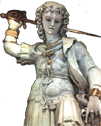
:::Who is like unto God?:::
|
With this seal in this ~MM: Jubilee-Year of our Lord with
his age: IV-years:
For this Ambassador: Glen-Martin: Samaritan of the Troy is founder of
this Christicelli/Christiasselli-Claim of this Catholic-Christian-Church-Community
as many living-cells in one body of our Brother, Redeemer, Lord and Saviour:
Jesus: Christ: King of all Kings in this Kingdom of this Heaven by the
Unity of the Trinity.
:::Thy will be done on Earth,
As, It is in Heaven.:::
|
::::locus-sigilli::::
:::omega::: |