:::alpha:::
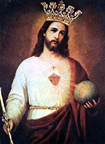
:::Banner of the Sacre-Coeur
of our Brother: King
of these Kings in his Kingdom
on his Earth in his Heavens,
as our Judge & Redeemer:::
|
:::Our Father,
who art in Heaven,
Holy be thy name:
Thy Kingdom Come:::
:Corporation-Sole:
|
:::sophia:::
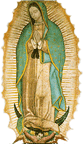
:::Stamp against all evil
by our Virgin-Mother: Queen,
Coredemptrix and
Mediatrix of all Graces,
as our Counselor & Advocate::: |
:Corporation-Sole:
The corporation sole is over five centuries
old and stems from Canon Law.
For the Office of the Pope(father)/Pontiff(bridge)
of the Roman-Catholic(Universal)-Church is with the form of a corporation-sole.
The Vatican gave formal approval of the
corporation sole as one of the methods of holding title of church property in
a private letter sent to the American bishops in 1911.
For the text, see: 2 T. Bouscaren,
Canon Law Digest 443 (1966)
A. Maida & N. Cafardl, Church Finances and Church Related Corporations 129
(1986)
The office of bishop in most dioceses in
the U.S. is a corporation sole.
4 New Catholic Encyclopedia, Corporation
337 (1967).
A current review as of 1988 reveals about
one-third of the diocesan bishops are corporations sole. The remainder of the
dioceses have small boards, usually appointed by the bishop.
See Maitland, The Corporation
sole , 16 Law Quarterly Review 335 (1900), reprinted in F. Maitland, Selected
Essays 73 (1936).
Corporation sole, a life of Cardinal
Mundelein, See E. Kantowicz, The Corporation sole (1983).
Most English speaking countries with a form
of government based on common or canon law (including the United States, Canada,
Latin America, and Caribbean Islands ) recognize corporation sole in two significant
ways. In the first instance, states acknowledge the office as prior existing,
provided the articles of incorporation are drafted so as to provide the pre-article
history of the office. In the second instance, states recognize a newly created
corporation sole by the simple filing of articles of incorporation. In this
latter instance, the articles do not reference any pre-incorporation history
of the office, as indeed none exists.
In statutory form encompassing both types of corporations sole seventeen states
in the United States of America recognize the corporation sole. The most favorable
are Nevada and Washington as the statutes are simple, the fees are minimal,
and the statute prohibits any annual fee or filings.
Hawaii Rev. Stat. Section 419-1to9
Nevada Rev. Stat. Section 84.010-080 (1985)
Washington Rev. Code ann. Section 24.12.010-040 (1969)
". . . Under a federal internal revenue
statute, 4 Fed Stat. Ann (2d ed.) Pp. 245-252; 38 Stat. At Large, chap. 16,
pp. 172-180, exempting the income of corporations sole organized and
operated exclusively for religious, charitable, scientific, or educational purposes,
no part of the net income of which inures to the benefit of any private stockholder
or individual. It has just recently been held by the United States
in the case of Trinidad v. Sagrada Orden de Predicadores, 44 Sup. Ct. 204, 68
L. Ed. 223, that a corporation sole, of an ancient religious order of
similar character to the one here under consideration, does not forfeit its
exemption by reason of incidental earnings and profits arising from its general
charitable operations, where none of its members share in the profits."
Santa Rosa Infirmary v. City of San Antonio (Tex. Com. App. 1925 ) 259 S.W.
926 at 934.
The doctrine of comity
involves the recognition that one sovereignty allows within the territory to
the legislative, executive, or judicial act of another sovereignty, having due
regard for its own citizens. In general, the principle of comity is that the
courts of one state or jurisdiction will give effect to the laws and judicial
decisions of another state or jurisdiction, not as a matter of obligation, but
out of deference and mutual respect. Brown v. Babbit Ford, Inc. 117 Ariz. 192,
571. P.2d 689, 685. Although the term "comity" is defined in Black's
Law Dictionary 6th ed. (1991) at page 267, the question is by no means clear
whether each state, county or other political subdivision thereof will automatically
recognize a corporation sole acknowledged by the Nevada Secretary of State.
"When a state departs from a generally
accepted rule of private international law, it is not denounced as a law-breaker
by judges or diplomats in other countries. English judges sometimes say that
their actions are dictated by comity;. This is an unusual word, and gives the
impression of being a technical term; however it is unclear what, if anything,
English judges mean when they use it. Its literal meaning is & courtesy
and in this sense comity is regarded as something different from law of any
sort; rules of comity are customs which are normally followed but which are
not legally obligatory. At other times is used as a synonym for private international
law; as a synonym for public international law; or as a totally meaningless
expression. It is a wonderful word to use when one wants to blur the distinction
between public and private international law, or to avoid clarity of thought."
Akenhurst, Modern Introduction
to International Law, 7th ed. (1996), p. 73.
The corporation sole is not taught in modern
law school classes. Lawyers are officers of the court and thus of the crown
of England. The sovereign in England is a sole corporation. Lawyers are not
taught about the kind of Trusts Rockefeller perfected to take control of the
oil, railroad, banking, medicine, law and government industries. Textbooks funded
by the Trusts left out information about their own status, thus gaining greater
privacy and power by limiting access to knowledge. The world is enslaved by
a secret society. The slaves work hard because they believe they are free.
:Common-Law: Corporation-Sole:
The common law form of the corporation sole,
a seriatim succession of persons who hold the same office, originally brought
to the American colonies is now rare. "A member of a corporation sole is
one of a series of single persons succeeding one another in some official position."
"There are very few points of corporation
law applicable to a corporation sole, according to Kent." There are, however,
four legal characteristics unique to it:
-
All corporations sole
are the incorporation of an office of "either public officers
or dignitaries of the established church." [or both in the
case of the Kingdom of Heaven, which is church and state, e.g. Ambassador
of the Kingdom of Heaven]
-
At common law,
the corporation sole can claim title to real property only.
-
Property and powers of
a corporation sole are transferred on the death of an incumbent to successors
in the office, "not to heirs or through executors."
-
The corporation
sole lacks the usual trappings of a corporation. It does not have a board
of directors, officers, stock, bylaws, official minutes, seal, or corporate
name. The older corporations sole are also devoid of a royal charter or
other formal authorization, "characteristics that are required
in later corporations."
Historically, both the king and a variety
of clergy qualified as corporations in their official capacities. The ecclesiastical
form is older, from the mid-fifteenth century. The corp-sole grew out
of judges solving title problems from passage of real property to a church.
Before the corp-sole, property was sometimes
devised to a saint after whom a parish was named, or to the four walls of a
church building, with the bishop or priest as the agent. Therefore, it was only
a short leap in logic to incorporate the agent."
It was another
150 fifty years before the first civil corporation sole, when Lord Coke ascribed
corporate-identity to the English crown. "Blackstone confidently called
this development uniquely English." Yet modern scholarship finds the influence
of Roman Catholic Canon Law.
The courts accepted some officers as corporations,
yet resisted the corporate claims of others similarly situated.
Questions:
-
What claims on corporate
property might arise from the heirs of a deceased incumbent?
-
What limits on fraudulent
transfer by a dishonest incumbent?
-
Is a separate accounting
required for the incumbent as a corporation and as a private person?
-
Is there a quasi-fiduciary
relationship between the corporation sole and his successors?
-
What happens to the corporation during
the illness or absence of the incumbent?
-
Who manages the property, and with
what legal force, during an interregnum?
:New-Forms:
"At a very early period the religious
establishment of England seems to have been adopted in the colony of Virginia,
and, of course, the common law upon that subject, so far as it was applicable
to the circumstances of that colony." Justice Story went on to count the
corporation sole as among the "general rights" of the Episcopal Church
"growing out of the common law. After the revolution, "the Episcopal
Church no longer retained its character as an exclusive religious establishment,"
but the Supreme Court still recognized the rights of the parson as a corporation
sole to continue in full force.
After the Declaration of Independence, early
case law indicated that the corporation sole lived on. "However, sometimes
it was found in its pure common law form, other times in a variant form."
In New England, title to the real property of territorial parishes was occasionally
vested in the resident clergyman. In the South, the Episcopal glebe was usually
held by the minister-in-charge (whatever his title), just as in England. "The
most numerous group of private corporations in the colonies comprises those
which were concerned with religious worship."
The corporation sole applied only to the
clergy of the churches that were legally and formally established. In an early
opinion written by Justice Story, the Supreme Court voided a royal grant of
land to the Episcopal Church in New Hampshire as no one was legally competent
to accept title, since New Hampshire never had an established church, even in
colonial days. The first amendment technically did not require states to disestablish
a church, but establishment was banned by the Bill of Rights. Some state officers
were accorded the civil form of the corporation sole after the Revolution, e.g.
the governor of Tennessee. Incorporation was not necessary to guarantee bonds
or contracts, or to continue lawsuits.
John Carroll was chosen the first Roman
Catholic bishop in the United States in 1789. Gaining secure title to the property
of the church in the various states and territories was one of his most pressing
and challenging tasks.
Roman Catholicism had no legal standing
in England and part of the impetus for revolution had been the granting of religious
freedom to Catholics in Canada by the Crown, seen as a threat of similar freedom
coming to the colonies. At that time, congregational ownership of church property
was practiced by many denominations in America, but was contrary to long-established
Roman Catholic policy.
Sometimes church property was held in fee
simple by the local priest or by a pious layman, but some feared that church
property held in a private name might be claimed by a relative of the holder.
In one lawsuit, an unfrocked priest claimed to be heir to land that a deceased
predecessor had purchased to build a church. Bishop Carroll won that suit, but
for the next seventy years the church sought a legally sufficient and
canonically suitable manner for its church to own property. The way
Carroll originally incorporated in Maryland was by vesting title in a board
of trustees, but "trusteeism" became an issue when some trustees used
their property ownership to pressure bishops in doctrinal and disciplinary disputes.
The sociopolitical "Know-Nothing"
movement objected to Catholicism and fought control of church property by the
clergy. The bishops defended the doctrine and practice of the religion, with
the corporation sole emerging as a major tool.
Starting in 1829, national bishops meetings
addressed property problems. Archbishop Whitfield of Baltimore sought a charter
in the form of a corporation sole from the Maryland General Assembly and it
was granted in 1832, A.D.
In the common law
corporation sole, when the incumbent died, the corporate life and activity was
held in suspension, or "abeyance", until the office was filled again.
In England
corporation sole was limited to Anglicans. The Roman Catholic Church was reinstated
in England in 1850. Catholic Canon Law did not envision a one-person corporation.
The minimum number required to constitute a "collegiate moral person"
was three." Even the Pope was not a corporation sole. Even though bishops
of dioceses have great autonomy in church law, favorable action by a board of
consultants is still required on major property decisions to this day.
Statutory Corporation Sole
As Roman Catholicism spread geographically
and grew in numbers in the last decade of the nineteenth century, new dioceses
were created as new areas of the country were settled. Where they could, the
bishops incorporated as a corporation sole. In some states, this required a
private act of special incorporation; in others, a general incorporation statute
was used.
On one occasion, a legislature defeated
a bishop’s request for sole incorporation on the grounds that Catholicism
would thus acquire a legal right not held by other religious denominations.
Ultimately, Roman Catholics won the battle for their church to be incorporated
in a manner consistent with church policy, although this put the Church
in contract with the State as a subject applying for a privilege.
Established by legislative action, the new
form of the corporation sole was now a creature of the state rather than the
common law. Judges began to require specific legislative authorization for a
corporation sole. The common law was not invoked to create sole corporations
in states where the legislature had not acted. Finally, at the beginning of
this century, the Supreme Court, in an opinion by Justice Holmes, confirmed
the judicial stance that apart from statute the law does not recognize the bishop
as a corporation sole.
The transformation of the corporation sole
from common law form to legislative form created something new. Zollmann, writing
in 1915, called it "a new form vigorously flourishing and American in the
true sense of the word." Momentum to secure the property rights of the
Roman Catholic Church a century ago left at least thirty states with corporation
soles in one form or another.
Seventeen states explicitly recognize the
corporation sole under statutory law, often in a special section for nonprofit
corporations or in a section on religious societies. At least eight other jurisdictions
have at least one corporation sole created under special or private charter,
sometimes dating to a time before the passage of a general incorporation statute.
The most complex issue regarding the old
corporation sole was that of continuing operation during a vacancy in the office.
The common law corporation sole was "in abeyance" at the time of a
vacancy, whereas the new corporation sole continues through temporary agents.
The common law corporation sole could hold title to real estate only, and alienation
of the property was difficult and legally questionable. The statutory corporation
sole has the same power over its property as any other corporation, and is not
limited in the type of property it can own.
Private charters have a parallel history.
The Maryland legislation incorporating the Archbishop of Baltimore dates to
1832. The law permits church property held by trustees to be deeded to the Archbishop
and his successors, but the property is limited to two acres, must be real property,
and can only be used for a church, parsonage, or burial ground.
In 1868, the Maryland legislature amended
the act. The acreage designation was enlarged to five acres, and "school
house" was added to the list of uses." A later amendment, in 1874,
granted the power "to dispose of, lease, sell and convey from time to time
to the same extent, [as] any private person or other corporate body."
In 1894, the Archbishop, as a corporation
sole, was given the power to exercise rights over property real, personal or
mixed. In 1927, the acreage restriction was completely removed. No further change
can now be made, because the Maryland code prohibits the General Assembly from
amending the charter of a religious corporation even if it was previously incorporated
by special act. The code now contains provisions for subsidiary or separate
Roman Catholic corporations.
The statutory corporation sole has a settled
existence. There has been no rash of new legislation, nor have there been any
repeals of earlier laws.
Special Circumstances
The constitutions of Virginia and West Virginia
specify that no charter of incorporation can be granted to any church or religious
denomination. Thomas Jefferson and James Madison were responsible for the tradition
of church-state separation in Virginia.
The Supreme Court of Arkansas, in dicta,
has recognized the Roman Catholic Bishop of Little Rock as a corporation sole
without any special act of the legislature.
The Supreme Court of Florida has
repeatedly held that the common law corporation sole is in full force in Florida.
The court relies on the fact that the common law has been adopted in
Florida and remains in force unless expressly or impliedly repealed by organic
or statutory law. This unique position initially attracted journal comment,
perhaps because it seemed contrary to the earlier United States Supreme Court
position.
Federal Corporation Sole
Congress voted, in 1811, to incorporate
an Episcopal church in the District of Columbia. President Madison vetoed and
implied that a charter of incorporation was an approval of a religion,
in violation of the Constitution.
In 1948, the Vatican severed the Archdiocese
of Washington from the Archdiocese of Baltimore. The new Archbishop of Washington,
with the help of President Truman, established a corporation sole by Congress
passing a private law.
Modern Form
A corporation sole is not a "one-person
corporation." A stock corporation is not transformed into a corporation
sole, simply because one person has purchased all of the stock.
The Roman Catholic Diocese of Wilmington
is a one-person corporation structured to operate like a corporation sole under
the general corporation laws rather than the Code for Religious Societies and
Corporations. This is made possible by provisions for a board of one, for non-stock
operation, and for formation of a close corporation in the general corporation
law.
Summary
For churches with a hierarchical structure,
especially the Roman Catholic Church, corp-sole is a secure method for both
ownership of property and daily operation. Statutory status is best in Nevada
or Washington state, while Florida upholds the common law.
:Claim of the Maxim: "_"
with the meaning: "_" is with the claim of the origin by
the century: ~_, Anno-Domini: author: _.
:Claim of the Etymology: For the word: _ is with the claim:
"_" with the ONLINE
ETYMOLOGY DICTIONARY by the Douglas: Harper. :Search.
:Claim of the Meaning with the English-language: For the term:
_
is with the claim: "_" with the Noah
Webster's 1828 American Dictionary of the English Language by the Noah:
Webster. :Search.
:Claim of the Meaning with the Law: For the term: _ is with
the claim: "_" with the Bouvier's
Law Dictionary, 1856 Edition (:Edition~1: 1839) by the John: Bouvier.
:Search.
:Claim of the Meaning with the Law: For the term: _ is with
the claim: "_" with the Douay-Rheims
Bible (:Challoner-version) by the Church. :Selection
of a Book :Search
of the Text.
:Claim of the Font: Italic: For
the use of the italic-font is with the common-tongue of the verb-fiction. For
a sample of this use is with the documentation for a quotation of a communication
with the writing or speaking by its author. For another sample of the use is
for the identification of the name of an fiction-entity.
:Claim of the Font: Bold: For
the use of the bold-font is for the emphasis with a matter for the benefit of
the ease of the identification and comprehension of the concepts of the document.
:Claim of the Font: Line: For
the use of the font with a line at the base of the letters is for the web-link
with the source for the confirmation of the matter, or with a page for the study
of a concept of the document.
:Claim of the Punctuation: Colon: For
the use of full colons is for the meaning as a phrase for the security of the
next-word:: meaning word with the nexus, as a noun.
:Claim of the Punctuation: Quotation: For
the use of the pairs of the opening and closing: quotation-marks is for the
meaning as the quotation of a communication by another party.
:Claim of the Punctuation: Box: For
the use of the pairs of the opening and closing: brackets, or parentheses is
for the lack of the joinder with the communication of the body of the document
by the law of the box. For the use of the box against the document is with the
meaning as a private-note for the edification of the reader by the author. For
the use of the box against a quotation is for the claims of the clarification
of the meaning of the quotation.
Links: Law;
Home
::CLAIM FOR HIS KINGDOM OF HIS HEAVEN
WITH THIS AMBASSADOR BY THE CHRIST::
For the sharing of these communications is for the spiritual-education,
healing-benefit and sanctification of each living-soul as a private-communion
with this minister, with the lack of any offer with the fiction-commerce of
this world and with the lack of any negotiability between all parties as these
cells in the Christ. For all truth and reality of all creation is with the ownership
by the Creator. For all matters in the universe of each moment are as the gift
for each soul with his love by our Lord. For any truth of these matters of this
page and site for the study is for the knowledge and freedom of the soul, with
the use with all love, charity, humility, honesty, wisdom and volition for the
good of all souls of our friends and enemies, foreign and domestic, as a gift
with the finding by the grace and will of our Lord. For all communications through
this Ambassador of the Christ are by this Glen-Martin of the Swartwout-family©-commonlaw-trade-name/copyright/COPYCLAIM/copy-Christ
with the claim of all powers for all truth in one law, with these claims with
the law by our Lord:
~I: U.C.C.: §: ~I: ~CIII (UCC 103)
with the correction of the language for the claims of the T.D.C.
with the correction of the language for the claim of the Threat, Duress and
Coersion by the Powers of this world against the will of our Lord; (Non
A)ssumsit-Contract with the correction
of the language for the lack of any authorization of any contract with the lack
of full closure with the claim of the meaning of each word in the truth with
the will by our Lord; and with the claim of the re:course for
the freedom against the compelling of any benefit and against any claim of an
occult-contract or claim of the commerce with any ficition; and with the claim
of all re:course by our Lord.
~II: U.C.C.: §: ~I: ~CIII: ~VI (UCC 103.6) with
the correction of the language for the claim of the common-Law
of this Christendom of the sojourners of this Earth in the Kingdom of the Heaven
with the creation and ownership by the Lord.
~III: U.C.C.: §: ~I: ~CCVII (UCC 207) with the
correction of the language for the claim of the re:medy for
the freedom of the contract against any force by the Powers of this world; with
the claim of the volition against any contract of a debt-discharge with any
association with the bankruptcy-scrip of the unity-States or with any fiction
or fraud with the conveyance of any value; and with the claim of all re:medy
by our Lord.
~IV: U.C.C.: §: ~I: ~CCVII: ~IV (UCC 207.4)
With(out) the (Pre)judice with the
correction of the language for the claim of the lack of any judgement of any
Man by another Man; and with the claim of the judgement by our Lord.
~V: U.C.C.: §: ~I: ~CCVII: ~VII (UCC 207.7)with
All Rights: (Re)serve(d) with the correction
of the language for the claim of all rights, freedoms and powers by the will
of our Lord.with the correction of the language for the claim against the waiver
of any powers with the gift by our Lord.
~VI: New-Covenant with the correction of the language for the
claim of one Law for the Love, Truth, Way and Life with the Will, Grace, Justice
and Mercy by our Lord.
~VII: '"The law was made for man, not man for
the law."' With the language correction of the claim: for the
making of the law for the Men is with the lack of the making of the Men for
the law, by our Creator.
:::'"the law is not made for a righteous man, but for the lawless
and disobedient"'::: ~I: Timothy: ~I: ~IX.
~VIII: :::'"To love all people and all things
is the key to being like God, the great lover"'::: Wisdom: ~XI:
~XXIV. :::'"You shall love your neighbor as yourself and the alien
too."'::: Leviticus: ~IXX: ~IIXX, ~XXXIV; For the heart of the
law is: love. :::'"You shall love the Lord your God with your whole
heart, your whole soul, your whole strength."'::: :Deuteronomy:
~VI: ~V.
~IX: :::'"I have not come to destroy the Law but to fulfill it.
Amen, I say to you, till heaven and earth pass away, not one jot or tittle of
the Law will be lost until it is all fulfilled…. Unless your justice exceeds
that of the scribes and the Pharisees, you shall not enter the kingdom of heaven."':::
Matthew: ~V: ~XVII, ~IIXX, ~XX.
:::Saint-Michael, Soul-Jah of the Archangel-family:::
:::Who is like unto God?:::
|
With this seal in this ~MM: Jubilee-Year of our Lord with
his age: IV-years:
For this Ambassador: Glen-Martin: Samaritan of the Troy is founder of
this Christicelli/Christiasselli-Claim of this Catholic-Christian-Church-Community
as many living-cells in one body of our Brother, Redeemer, Lord and Saviour:
Jesus: Christ: King of all Kings in this Kingdom of this Heaven by the
Unity of the Trinity.
:::Thy will be done on Earth,
As, It is in Heaven.:::
|
::::locus-sigilli::::
:::omega::: |