:::alpha:::
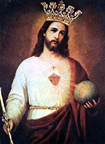
:::Banner of the Sacre-Coeur
of our Brother: King
of these Kings in his Kingdom
on his Earth in his Heavens,
as our Judge & Redeemer:::
|
:::Our Father,
who art in Heaven,
Holy be thy name:
Thy Kingdom Come:::
:Court:
|
:::sophia:::

:::Stamp against all evil
by our Virgin-Mother: Queen,
Coredemptrix and
Mediatrix of all Graces,
as our Counselor & Advocate::: |
:Court:
:Court of the Scriptures of the
Law of Our Lord:
~I: Open-Space within a Closure:
The word court in the English Bible corresponds to the Hebrew haçer
meaning enclosed space, which designates:
-
an encampment
of nomads (on our sojourn to the Heavens);
-
a space protected
(by the offer, acceptance and compliance with the Law in the Truth)
by a stockade or palisades, or by a rampart of stones or earth, hence a
village (Joinder);
-
the court-yards
of the houses or temples. In the first sense the Hebrew term is,
in the D.V., rendered in various ways: "castle"
(Gen., xxv, 16), "cities of the desert" (Is.,
xlii, 11), "private places" (i.e. places
of ambush near the settlements, Ps. ix, 8).
The word village usually expresses
the second meaning (Lev., xxv, 31; Jos., xiii, xv, xvi, etc.; I Par., iv, 33,
etc. However, in Ex., viii, 13, village is a mistranslation for court-yard).
In connection with this sense it may not be amiss to notice that the Hebrew
word, either in the form Haçer, or in the slightly different
form Haçor was not infrequently used in proper names.
One of the first encampments of the Hebrews after their departure from the foot
of Mount Sinai was at a place called Haseroth (Num,
xi, 34). There was a Chanaanite city of Asor near
the waters of Merom (Jos., xi, 5; Josephus, Ant. Jud., V, v, 1); this city,
taken and burned by Josue (Jos., xi, 10, 11), was allotted to the tribe of Nephtali
(Jos., xix, 36), but probably rebuilt by the Chanaanites (Judges, iv, 2), fortified
by Solomon (III K., ix, 15), and seized by Theglathphalasar (IV K., xv, 29).
This Asor or Aser was, according to the Greek text,
the native place of Tobias (Tob., i, 2), and at a short distance from it Jonathan
Machabeus defeated the army of Demetrius (I Mach., xi, 67). We read (Jos., xv,
23) of another Asor, called Esron, in Jos., xv, 3,
and Hesron, xv, 25 on the southern frontier of Juda.
The same text (xv, 25) even mentions in the same borders a New Asor. A third
Asor existed, at least after the Captivity, near Jerusalem, in the territory
of Benjamin (II Esd., xi, 33). Among the compound proper names may be mentioned:
Hasar Adar (D. V., "the town called Adar",
Num., xxxiv, 4); Asergadda (Jos., xv, 27); Hasersusa or Hasarsusim (Jos., xix,
5; I Par., iv, 31); Hasar Enon (D. V., "court of Enan", Ez., xlvii,
17; xlviii, 1; "village of Enan", Num., xxxiv, 9, 10); Hasersual or
Hasarsuhal (Jos., xv, 28; xix, 3; II Esd., xi, 27; I Par., iv, 28); Hasar hattikhon
(D. V., "the house of Tichon", Ez, xlvii, 16); Baalhasor (II K., xiii,
23); Enhasor (Jos., xix, 37).
The recent excavations in Syria and Palestine, as well as the modern customs
inherited from olden times, give precise indications concerning the house-courts,
not seldom alluded to in Holy Writ. When, as occurs frequently, the house does
not open directly on the street, there is a first court-yard extending between
the outer wall and the building. From this outer court an entrance doorway leads
into the inner court, around which the various apartments are located. The inner
court sometimes contains in the centre a well (II K., xvii, 18) or a fountain
surrounded with fine trees; the walls, porches, and verandas are usually covered
with vines and creepers, and an awning may be stretched overhead to keep off
the sun. From the narration of the Passion we may infer that such was the arrangement
in the high-priest's house. While Jesus was being tried in one of the halls,
the servants and ministers had gathered around a fire of coals in the inner
court; thither Peter came to warm himself, and there he denied his Master. From
the judgment-hall, Jesus turning (Luke, xxii, 61) could easily look outside
(Matt., xxvi, 69) on Peter. Then the latter, smitten with remorse, betook himself
to the outer court (Mark, xiv, 68; D. V., "before the court", a literal
translation of the awkward Latin rendering: ante atrium ), there to weep freely.
Royal residences displayed, on a larger scale and in a more elaborate way, a
similar general arrangement. The Bible speaks of the courts of the palaces of
Solomon (III K., vii, 9, etc.), Ezechias (IV K., xx, 4), and Sedecias (Jer.,
xxxii, 2, 12; xxxiii, 1; xxxvi, 20; xxxviii, 6), as well as those of Assuerus
at Susan (Esth., ii, 11; iv, 11; v, 2; etc.) and of Seleucus at Tyre (II Mach.,
iv, 46). In connexion with sacred places, courts are most frequently mentioned.
We learn from Ex., xxxviii, 9 sq. that the place of meeting in the wilderness
was a court, a hundred cubits long and fifty cubits wide, encompassed by pillars
supporting hangings of fine twisted linen. The sacred precincts contained, besides
the tabernacle and its furniture, the altar of holocausts and the brazen layer
(Ex., xl, 6, 7). Still more famous are Solomon's constructions. All the buildings
erected by this prince on Mount Sion were surrounded by a wall encompassing
what may be styled "the greater court". Southernmost in the lowest
court were the public balls, namely: the "house of the forest of Libanus",
the "Porch of pillars", and the throne-hall; farther in from the throne-hall
(III K., vii, 8, Heb. text) and on a higher level another court, called "middle
court", IV K., xx, 4 (Heb.; D. V., "the middle of the court"),
contained the king's mansion and the house built for Pharao's daughter (III
K., vii, 8). North of the middle court, on the top of the hill, was the "inner
court" (III K., vi, 36), also called "upper court" (Jer., xxxvi,
10) and "court of the priests" (II Par., iv, 9). No information is
supplied by the Sacred Text about the extent and form of this latter court.
Judging, however, from the second and third temples, it would seem to have been
rectangular; the rabbis say that it measured 135 (N. to S.) by 187 (E. to W.)
cubits; but these figures, obtained from the traditions concerning the second
temple, can claim no certainty. The floor of the inner court was paved with
stones (II Par., vii, 3; IV K., xvi, 17, has no reference to this point; pavement
in the English Bibles ought to be understood here: stone basement). The descriptions
of III K. and II Par. mention no gates, but some must have existed; one, very
likely, on the south side, connecting the temple court with the middle court,
and others probably on the north and east sides for the accommodation of the
people. At any rate, that some time before the Exile there were gates is evidenced
by such passages as Jer., xxxviii, 14; IV K., xxv, 18 (cf. Jer., lii, 24). An
eastern gate is said (I Par., ix, 18) to have existed; it was called "the
king's gate". To Joatham is attributed (IV K., xv, 35) the construction
of "the highest gate of the house of the Lord", most probably the
same as the "upper gate of Benjamin" of Jer., xx, 2, or the "new
gate" of Jer., xxvi, 10, xxxvi, 10, and perhaps also the "gate of
the altar" of Ez., viii, 5; all these passages point out a gate on the
north side. Within the inner court were the temple proper, the altar of holocausts,
the brazen sea, and layers. All the walls encircling these various courts "were
made of three rows of hewn stones and one row of cedar beams" (III K.,
vii, 12). Modern archæologists are inclined to attribute to the son of
David these courses of huge stones which may be seen in various places of the
walls of the Haram esh-Sherif. We possess little information concerning the
second temple; but there are reasons to believe that, with the exception of
the temple-house, which was certainly smaller, the arrangement and dimensions
were about the same as those of Solomon's temple. In Herod's time the temple
area was extended towards the north, according to some; towards the south, in
the opinion of others, so that the outer court had probably the same form and
dimensions as the actual Haram. This court was surrounded by a high wall covered
with spikes. Along the walls on the inside, north, west, and east (Solomon's
Porch), were double porticoes, and on the south a triple portico, the "royal
porch". Eight gates gave access from the outside: four on the west, two
on the south (Huldah gates), one on the east, and one on the north (Tadhi gate);
between the gates, along the outer walls, halls and chambers had been erected,
among which we may mention the Beth-Din, or meeting-place of the Sanhedrin.
Within this outer court, towards the north, a wall forty cubits high, limited
the inner court. All around this wall extended a terrace (the hel ) ten cubits
wide and reached by a flight of fourteen steps. A stone parapet, about a cubit
high, encircled the inner edge of the hel , to which thirteen openings gave
access; on the parapets tablets warned, under penalty of death, the non-Jews
against trespassing. From the hel nine gates and stairways led the Israelites
into the inner courts. On the inside, along the walls, twenty-five cubits high
(the ground was some fifteen cubits higher than the court of the Gentiles),
ran porticoes, and cells for sundry purposes had been erected between the gates.
The walls of the inner court encompassed two distinct spaces: the eastern part,
called "the women's court", which, among other things, contained the
boxes for the various collections; thence a gate, preceded by a flight of fifteen
steps, led to the western part, or "men's court". There a balustrade
separated the "priests' court", containing the temple proper and the
altar of holocausts and all their appurtenances, from the place assigned to
the lay people.
~II: Attendance of a King
In the English Bible the word court is occasionally used also to mean the retinue
of a person of high rank and authority (Gen., xlv, 16; IV K., vii, 9; Esth.,
xi, 3). It then stands generally for the Hebrew word hel,
"house", the only word which, in the sacred language, might
in some instances, receive the sense with which we are now concerned. The Latin
Bible in such places usually has the noun: aula,
and once in the N. T. exercitus (Luke, xxiii,
11). The kings of Israel and Juda had their court of their
family, body-guard, counsellors, secretaries, recorders, chancellors, ministers,
superintendents of public works, governors of the house, and high dignitaries
of the temple. Glowing descriptions are given of the splendour of the
court of such kings as David (II K., xxiii; I Par., xi) and Solomon
(Cant., iii, 7, 8); later Jewish writers relate these images to the
glory of the palace of God, who is king ofIsrael and the whole world, and a
king must have his court: host of the angels, for the acts by His will.
Seven forever stand in His presence; legions of seraphim surround his throne,
as a body-guard; thousands of heavenly spirits form his council (Tob., xii,
15; Is., vi, 2, 6; Pss. lxxxii, lxxxix). Ecclesiastical writers describe
the heavenly court with the angels and Saints as the host of all souls
with the beatific-vision. Mystic writers also see the courts of the
Temple as a figure of the souls striving for Christian perfection: the
brazen layer represents the purifying penance, whereas the altar of holocausts
signifies Christian mortification and its necessary sacrifices. :Source
U.S.: Article III Courts:
We
The People are looking for a Constitutional Article III Court to Petition
the Government for a redress of Grievances. The Buck Act and 28 USC 132 removed
the courts into Federal areas.
Justice Clark writes: "...the Congress
had declared the Court of Claims "to be a court established under article
III of the Constitution of the United States." Act of July 28, 1953, §
1, 67 Stat. 226." He also writes: "Likewise, I find that the Court
of Customs and Patent Appeals has been an Article III court since 1958."
:Source.
VICE-ADMIRALTY COURTS.
In English Law. Courts established in the
queen's possessions beyond the
seas, with jurisdiction over maritime causes, including those relating to
prize. Some of the States are lawfully the possession of the English Crown by
the original commercial joint venture agreements between those colonies and
the Crown. The Constitution brought the States (only) back under British ownership
and rule as a bankruptcy document. The American people had gained sovereign
standing in law, independent of the states and the Crown. To bring them back
under British Rule, the commercial process is the method of choice via the 14th
Amendment, registration of birth certificates and property. All courts in
America are now Vice-admiralty courts in the Crown's private commerce.
:Claim of the Maxim: "_"
with the meaning: "_" is with the claim of the origin by
the century: ~_, Anno-Domini: author: _.
:Claim of the Etymology: For the word: _ is with the claim:
"_" with the ONLINE
ETYMOLOGY DICTIONARY by the Douglas: Harper. :Search.
:Claim of the Meaning with the English-language: For the term:
_
is with the claim: "_" with the Noah
Webster's 1828 American Dictionary of the English Language by the Noah:
Webster. :Search.
:Claim of the Meaning with the Law: For the term: _ is with
the claim: "_" with the Bouvier's
Law Dictionary, 1856 Edition (:Edition~1: 1839) by the John: Bouvier.
:Search.
:Claim of the Meaning with the Law: For the term: _ is with
the claim: "_" with the Douay-Rheims
Bible (:Challoner-version) by the Church. :Selection
of a Book :Search
of the Text.
:Claim of the Font: Italic: For
the use of the italic-font is with the common-tongue of the verb-fiction. For
a sample of this use is with the documentation for a quotation of a communication
with the writing or speaking by its author. For another sample of the use is
for the identification of the name of an fiction-entity.
:Claim of the Font: Bold: For
the use of the bold-font is for the emphasis with a matter for the benefit of
the ease of the identification and comprehension of the concepts of the document.
:Claim of the Font: Line: For
the use of the font with a line at the base of the letters is for the web-link
with the source for the confirmation of the matter, or with a page for the study
of a concept of the document.
:Claim of the Punctuation: Colon: For
the use of full colons is for the meaning as a phrase for the security of the
next-word:: meaning word with the nexus, as a noun.
:Claim of the Punctuation: Quotation: For
the use of the pairs of the opening and closing: quotation-marks is for the
meaning as the quotation of a communication by another party.
:Claim of the Punctuation: Box: For
the use of the pairs of the opening and closing: brackets, or parentheses is
for the lack of the joinder with the communication of the body of the document
by the law of the box. For the use of the box against the document is with the
meaning as a private-note for the edification of the reader by the author. For
the use of the box against a quotation is for the claims of the clarification
of the meaning of the quotation.
Links: Law;
Home
::CLAIM FOR HIS KINGDOM OF HIS HEAVEN
WITH THIS AMBASSADOR BY THE CHRIST::
For the sharing of these communications is for the spiritual-education,
healing-benefit and sanctification of each living-soul as a private-communion
with this minister, with the lack of any offer with the fiction-commerce of
this world and with the lack of any negotiability between all parties as these
cells in the Christ. For all truth and reality of all creation is with the ownership
by the Creator. For all matters in the universe of each moment are as the gift
for each soul with his love by our Lord. For any truth of these matters of this
page and site for the study is for the knowledge and freedom of the soul, with
the use with all love, charity, humility, honesty, wisdom and volition for the
good of all souls of our friends and enemies, foreign and domestic, as a gift
with the finding by the grace and will of our Lord. For all communications through
this Ambassador of the Christ are by this Glen-Martin of the Swartwout-family©-commonlaw-trade-name/copyright/COPYCLAIM/copy-Christ
with the claim of all powers for all truth in one law, with these claims with
the law by our Lord:
~I: U.C.C.: §: ~I: ~CIII (UCC 103)
with the correction of the language for the claims of the T.D.C.
with the correction of the language for the claim of the Threat, Duress and
Coersion by the Powers of this world against the will of our Lord; (Non
A)ssumsit-Contract with the correction
of the language for the lack of any authorization of any contract with the lack
of full closure with the claim of the meaning of each word in the truth with
the will by our Lord; and with the claim of the re:course for
the freedom against the compelling of any benefit and against any claim of an
occult-contract or claim of the commerce with any ficition; and with the claim
of all re:course by our Lord.
~II: U.C.C.: §: ~I: ~CIII: ~VI (UCC 103.6) with
the correction of the language for the claim of the common-Law
of this Christendom of the sojourners of this Earth in the Kingdom of the Heaven
with the creation and ownership by the Lord.
~III: U.C.C.: §: ~I: ~CCVII (UCC 207) with the
correction of the language for the claim of the re:medy for
the freedom of the contract against any force by the Powers of this world; with
the claim of the volition against any contract of a debt-discharge with any
association with the bankruptcy-scrip of the unity-States or with any fiction
or fraud with the conveyance of any value; and with the claim of all re:medy
by our Lord.
~IV: U.C.C.: §: ~I: ~CCVII: ~IV (UCC 207.4)
With(out) the (Pre)judice with the
correction of the language for the claim of the lack of any judgement of any
Man by another Man; and with the claim of the judgement by our Lord.
~V: U.C.C.: §: ~I: ~CCVII: ~VII (UCC 207.7)with
All Rights: (Re)serve(d) with the correction
of the language for the claim of all rights, freedoms and powers by the will
of our Lord.with the correction of the language for the claim against the waiver
of any powers with the gift by our Lord.
~VI: New-Covenant with the correction of the language for the
claim of one Law for the Love, Truth, Way and Life with the Will, Grace, Justice
and Mercy by our Lord.
~VII: '"The law was made for man, not man for
the law."' With the language correction of the claim: for the
making of the law for the Men is with the lack of the making of the Men for
the law, by our Creator.
:::'"the law is not made for a righteous man, but for the lawless
and disobedient"'::: ~I: Timothy: ~I: ~IX.
~VIII: :::'"To love all people and all things
is the key to being like God, the great lover"'::: Wisdom: ~XI:
~XXIV. :::'"You shall love your neighbor as yourself and the alien
too."'::: Leviticus: ~IXX: ~IIXX, ~XXXIV; For the heart of the
law is: love. :::'"You shall love the Lord your God with your whole
heart, your whole soul, your whole strength."'::: :Deuteronomy:
~VI: ~V.
~IX: :::'"I have not come to destroy the Law but to fulfill it.
Amen, I say to you, till heaven and earth pass away, not one jot or tittle of
the Law will be lost until it is all fulfilled…. Unless your justice exceeds
that of the scribes and the Pharisees, you shall not enter the kingdom of heaven."':::
Matthew: ~V: ~XVII, ~IIXX, ~XX.
:::Saint-Michael, Soul-Jah of the Archangel-family:::
:::Who is like unto God?:::
|
With this seal in this ~MM: Jubilee-Year of our Lord with
his age: IV-years:
For this Ambassador: Glen-Martin: Samaritan of the Troy is founder of
this Christicelli/Christiasselli-Claim of this Catholic-Christian-Church-Community
as many living-cells in one body of our Brother, Redeemer, Lord and Saviour:
Jesus: Christ: King of all Kings in this Kingdom of this Heaven by the
Unity of the Trinity.
:::Thy will be done on Earth,
As, It is in Heaven.:::
|
::::locus-sigilli::::
:::omega::: |