:::alpha:::
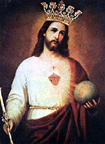
:::Banner of the Sacre-Coeur
of our Brother: King
of these Kings in his Kingdom
on his Earth in his Heavens,
as our Judge & Redeemer:::
|
:::Our Father,
who art in Heaven,
Holy be thy name:
Thy Kingdom Come:::
:Corporation:
|
:::sophia:::

:::Stamp against all evil
by our Virgin-Mother: Queen,
Coredemptrix and
Mediatrix of all Graces,
as our Counselor & Advocate::: |
: Corporations:
"I hope we shall ...crush in
its birth the aristocracy of our moneyed corporations which dare already to
challenge our government to a trial of strength, and bid defiance to the laws
of our country."
- Thomas Jefferson
America moves into its second 70 year international
bankruptcy, beginning in 1859. The War by the Criminal against the Civil (i.e.
Civil War) extends the offer of slavery to all Americans under Martial rule
(no Law). The United States is reorganized as a corporation in 1871, filing
in London.
| Dead-at-law legal fiction corporations are first
claimed to have the rights of a living person in 1886 by Chief Justice M.R.
Waite, a member of the secret corporation: Skull and Bones, founded in 1832
with opium money. The son of co-founder Alphonso Taft is the only man to
serve as both President and Chief Justice: William Howard Taft. |
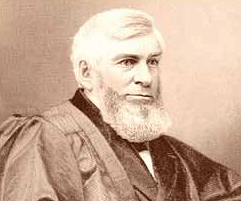
Chief Justice M.R. Waite
|
Under the Clearfield Doctrine,
derived from the 1943 Supreme Court Decision in Clearfield Trust, et al. vs.
United States, (328 U.S. 363, 318), the court ruled,
in essence, that when a government reduces itself to a corporate status,
it becomes merely another corporation, having no more nor less standing
than all other corporations. See: The
Modern Robber Barons.
"From the earliest of times the law
has enforced rights and exacted liberties by utilizing a corporate concept-
by recognizing, that is, juristic persons other than human beings. The theories
by which this mode of legal operation has developed, has been justified, qualified,
and defined are the subject matter of a very sizable library. The historic roots
of a particular society, economic pressures, philosophic notions, all have had
their share in the law's response to the ways of men in carrying on their affairs
through what is now the familiar device of the corporation. Law has also responded
to religious needs in recognizing juristic persons other than human beings."
[U.S. v. Scophony Corporation of America, 333 U.S. 795 (1948)]
You are a CORPORATION until you
deny it via an Affidavit
For example, in Texas: TRCP 52 ALLEGING
A CORPORATION: An allegation that a corporation is incorporated shall be taken
as true, unless denied by the affidavit of the adverse party, his agent or attorney,
whether such corporation is a public or private corporation and however created.
Dr. Pepper Co. v. Crow , 621 S.W.2d 464,465 (Tex App.—Waco 1981, no writ).
"Plaintiff plead defendant was a corporation. Defendant did not deny by
verified pleading pursuant to [TRCP] 52 and 93 ... that it was not a corporation;
thus, such fact was established."
The all capital letters name on your straw man's Driver License, Voter Registration,
and Social Security card is not you, but you have contracted to be responsible
for the all Caps name putting you into voluntary slavery. You made the choice
and only you have the power to change your choice and your status. The fiction
entity you represent can do nothing, as it does not really exist.
The UNITED STATES defines the fictitious entity spelled like your name with
upper case letters as a "corporation" in 15 USCA (United States Code
Annotated) section 44: "Corporation" shall be deemed to include any
company, trust, so-called Massachusetts trust, or association, incorporated
or unincorporated, which is organized to carry on business for its own profit
or that of its members…."
Legal person v. lawful Christian
The lawful Christian name of your birthright
and re-birth at baptism: First-Middle of the Last-family, is being attached
and attacked by a legal fiction: FIRST M. LAST, a member of the dead at law
PUBLIC, created as a corporate subsidiary of the government that has devolved
into mere corporation status in commerce/war against its own people.
Through generations of PUBLIC schooling, when the lawful living Christian answers
as though he is the ficticious legal person, the two are presumed to be one.
Christ says "Who do you say that I am?" If the lawful man knows who
he is, the two are as separate as Heaven and HELL.
Federal government bankruptcy reorganization created a legal fiction: THE UNITED
STATES registered as a corporation in London in 1871. Each State, e.g. New York
State, an organization of living people, was also reorganized into a corporate
STATE: e.g. STATE OF NEW YORK, which can only deal with other corporate fictions,
such as the INDIVIDUAL or PERSON created by bastardizing your Christian name
to create a misnomer that you could be trained to confuse with your true name
and identity.
Legal fictions can only create other legal fictions. STATE OF NEW YORK cannot
have babies, only CERTIFICATES OF LIVE BIRTH.
All de facto governments are now operating in fiction. For example, a U.S. DISTRICT
COURT can only recognize legal persons, so your lawful name is never used with
full accuracy in their records. They will always use an initial, lack of correct
punctuation or some other corruption of the true name, even if using 'first
letter upper-case only'. Typically, the unlawful, but legal person is written
with full caps. Jurisdiction in legal fiction courts is only with other legal
fictitious entities.
The only jurisdiction a lawful Christian can enter is a lawful constitutional
court of common law venue. Lawful courts are no longer operated by the de facto
government.
One solution is for lawful Americans to know that they are not the legal fiction.
Lawful Americans can also seek and create lawful government and lawful courts.
Legal fiction can only end when the living people stop playing dead. You can
give back privileges with adhesion contracts, and restore your God-given powers
of self governance in lawful community.
A vessel of the United States is defined in Title
18 USC Section 9:
"Vessels of the United States defined.
The term vessel of the United States as used in this title
[CRIMES AND CRIMINAL PROCEDURES] means a vessel belonging
in whole or in part to the United States or any citizen thereof or any corporation
created by or under the laws of the United States or any State or Territory
or district or possession."
A Corporation is a contractual body. It
is either a body of fact or of fiction. A corporation is a slave, either to
God or Satan.
Corporations are entities of fiction, creations
of the human mind, except for one: the Catholic Church, the true Kingdom of
Heaven, the real Nation of Israel with all its subsidiaries: Orders, Dioceses,
Churches, Monasteries, Cloisters, Communities, Families. The Church was founded
by the God-Man: the annointed King of Kings: Jesus Christ, our Lord and Master.
All the governments of the world are actually
corporations. What we usually think of as corporations are actually subsidiaries
of these nation-corporations. Satan tried to tempt Christ during his 40 day
fast in the desert by offering him all the nations of the world. Satan could
offer these because they belong to him: they are his slaves, as are the corporations
subsidiary to these false-notion nations: what I call the imagi-nations of the
world.
Why is time of day measured from Greenwich
mean time, England and why is Longitude measured from London?
Yet, we still meaure the year from the time
the Blessed Virgin: Mary, Queen of the Heavens and of the Earth, of the Saints
and Angels gave birth to the most perfect child: Jesus, God with us. We are
just travellers for a brief time here on our Heavenly Mother's Earth, as we
were in our Earth-Mother's womb. Our nationality, our alliegence, our home is
in the Kingdom of Heaven into which we are born by the Sacrament of Baptism.
The United States gained independence from
the London bankers only until the Constitution was adopted as an international
bankruptcy document, sweetened with the fiction bill of rights. The founding
fathers began as debt-slaves to the bloody anti-Catholic, anti-Royal French-Revolution,
having borrowed 3 million francs to fund their hostile takeover bid for management
of the 13 English colonies. When they failed to meet their payments following
the war, the new country was governed under the Articles of Confederation until
the end of the 7 year bankruptcy to France. Then France sold the failed note
to England for the following 70 year international bankruptcy.
The first international bankruptcy ended
in Civil War over who would be slave to London and
pay the debt. There has been no effective Civil government of even flying of
the Civil flag since the Civil War.
Did you know that the United States of America
was formally filed as a corporation in London in 1873?
Corporations grew in power during the 19th
century, and their owners wanted to expand their legal rights as well. Since
owners or shareholders couldn't be held personally liable, they argued, the
corporation itself should be treated as a "person" thus entitling
it to all the protections of the Constitution. The argument was accepted by
the U.S. Supreme Court in 1886, in the case of Santa Clara County v. Southern
Pacific Railway Company. Consequently, a corporation today has the right to
free speech, the right to own property, and the right to due process of law,
just as a
person does.
The second international bankruptcy ended
in London calling in all loans resulting in the Crash of 1929.
The perverse genius of the modern corporation
is not just that it maximizes profit by offloading as many costs (employee education,
environmental cleanup, health impact of products) as possible onto the public;
it also enables owners and managers to simultaneously claim that each other
are ultimately responsible for the corporation's actions.
America came out of bankruptcy briefly in
1999, followed by the British coup that put the royal
relative Bush in charge of bringing U.S. back into slavery. Bush, America's
new King George II, gaining the throne by patrimony
rather than election, is the first American President invited to dinner with
the Royal family. And rightly so...he conquered the newly free and strongest
nation on earth: America, for the false crown of the London bankers.
Remember, Christ our King is King of Kings.
We are those real Kings. Real Kings are not Kings of imagi-nations, mere pretend-owners
(usurpers) of real-estate created by God for all of our benefit and use, but
regal leaders of men and women and children on our mystical journey to Heaven.
Kings are servants of God, seeing God in each of His cells that we are. Governance
is about our real estate of a regal-estate in Heaven, not the false-state's
notion of 'real-estate.' The only clear and real governance is self-governance
as subsidiary corporations of the Creator. All else is a mud of fantasy and
coercion.
Peace be with you,
:::Glen-Martin:::
:Law of the Name:
Legal and commercial documents such as driver
licenses, credit cards, utility bills typically use names in all capitals. What
is the volition for such a corruption of the name of a living human being? The
name of a living human being is written in the form known as Initial
Capitals or First Letter Upper Case Only by the Common
Law of the Land of the living.
ALL CAPITAL LETTERS names
are used in the great sea that engulfs the entire world today: Admiralty/Maritime/Martial-Equity
systems of legal-fiction for the purposes of war (confusion) and commerce (contract).
In war, such as the war formally declared by the London-registered corporation
(1871): THE UNITED STATES OF AMERICA against the American people starting in
1933, the all cap name is known in law as a NOM DE GUERRE, meaning: name of
war (with war used as a verb). A brief modern dictionary definition
is: [n] a fictitious name used when the person performs a
particular social role. When a combatant fails to respond to mail for
30 days, he is presumed dead and his name is listed in all capital letters as
a dead at law entity, a presumed cadaver. In our modern fiction world economy,
created as a Debtor's Prison
Planet, the social role we are trained to mis-identify as our Selves is
that of the dead at law DEBTOR, which is not us, but a ROLE
that we play. The balancing role we can play in this fiction is Creditor.
Who we really are is living souls, living cells in God's body, royal brothers
and sisters in the sovereignty of the Christ. We are Baptised with the water
for an indellible mark of our Master. We are safely in the ship of the Barque
of Peter, protected under the mantle of our blessed Queen
and defended in the Admiralty battles and against all Maritime Privateers and
Pirates by Saint Michael, the Archangel. In the Truth,
we can only be a debtor and Bond-servant to our True Creditor, the Creator.
All that is, is created for each of us as fresh gift in each succeeding moment.
We can truly only acquire perfect, quiet title to anything one moment at a time
through perfect acceptance of God's Will in gifting it to us for our use. We
can never lend or borrow any thing without God's gift of the thing into creation.
We can never fail to lend a hand of the use of a thing for the benefit of another
soul, if we see our Benefactor in the soul of the Other.
"In order to rightly comprehend a thing, inquire first into the names,
for rightful knowledge of things depends upon their names.”
A name is a noun, a thing, that stands as a symbol for the actual thing. A name
is an expression whose form has legal and lawful significance. “John Henry
Doe” is in the form of a true name in accordance with
the rules of English grammar and prescriptions of law, while “JOHN HENRY
DOE,” is a corrupted variant. Corruption in the body is desease and leads
to death, and the same is true in the name. Studies show that text in ALL CAPS
is very hard to read. It is known as a SHOUT and it is a legal
fiction.
The true name of a man (of either gender), when its facts are modified into
ALL CAPITAL LETTERS (with or without abbreviation or initials) , is a corporately
colored (colored = fiction, appearance) corruption of the true name. This trade
name, a corporately colored corruption of your real name is your intellectual
property. Your property is being used for commercial gain by agencies, courts,
military, IRS, banks, etcetera. You can reclaim control of your trade name through
the Common Law by publishing a Notice of Copyright, and in the Truth by a COPYCLAIM.
The way in the spirit is: Copy-Christ.
The Latin legal term for such constructs or entities is ens legis:
“Ens Legis. L. Lat. A
creature of the law; an artificial being, as contrasted with a natural person.
Applied to corporations, considered as deriving their existence entirely from
the law.”
Blacks Law
Dictionary, Fourth Edition, 1951.
Your TRADE NAME can be established with a copyright and/or as a trade name (for
services), trademark (for goods), and/or service-mark by you as the owner, for
the purpose of restricting unauthorized use and unjust enrichment of other parties
at the expense of the owner who has invested time and energy to build the
good name and reputation, known as good will, of your trade name. Statutory
entities must follow statutory law about using such names. Living, breathing,
flesh-and-blood men need only assert and claim their copyright through the common
law.
“Common Law. As distinguished from law created by
enactment of legislatures, the common law comprises the body of those
principles and rules of action, relating to the [self-]government and
security of persons and property, which derive their authority solely from
recognizing, affirming, and enforcing such usages and customs;
and, in this sense, particularly the ancient, unwritten law of England.”
Blacks Law
Dictionary, Fourth Edition, 1951.
Proper names in all capital letters are trade names for artificial persons.
An artificial person is not the same person as the natural person whose property
it is. Similarly, any corporation name is a symbol for an artificial legal entity
separate and distinct from it’s owners.
Artificial persons, such as the one your trade name symbolizes, also know as
a front, or straw-man, can only interface with other nominal parties, or front
entities, in the fiction, such as corporations.
“Stramineus homo: A man of straw, one of no substance, put forward as
bail or surety.”
Blacks Law
Dictionary, First Edition, 1891.
A landmark Supreme Court case of 1795, which has never been overturned, Penhallow
v. Doane’s Administrators (3 U.S. 54; 1 L.Ed. 57; 3 Dall. 54), defines
governments succinctly:
“governments are corporations.” Inasmuch as every
government is an artificial person, an abstraction, and a creature of the mind
only, a government can interface only with other artificial persons.
The imaginary-having neither actuality nor substance-is foreclosed from creating
and attaining parity with the tangible. The legal manifestation of this
is that no government, as well as any law, agency, aspect, court, etc.
thereof, can concern itself with anything other than corporate, artificial persons
and the contracts between them. One might immediately dispute
this statement by pointing out that people are acted upon by agents of the government
and are regulated, fined, imprisoned, plundered, brutalized, and killed
by government officials everyday. True, but let us step back from the
fray and take in the whole macrocosm that we call “modern civilization.”
“Surety A person who is primarily liable for the
payment of another’s debt or the performance of another’s obligation.”
Blacks Law
Dictionary, Seventh Edition.
Without disclosure or informed consent, you as the sovereign are treated as
a surety for your artificial STRAW MAN, after you authorize a contract with
your autograph. By identifying yourself as “authorization-agent"
or "agent with the authority” you give notice that you are not a
surety for the STRAW MAN.
Begin the process of establishing control by publishing a common law copyright
and filing a UCC-1 claim against your STRAW MAN in the region where you were
born. Object to any claim that your status is as a citizen of a Federal territory
because of Fourteenth Amendment. Source
U.S. Government Printing Office
Style Manual. (2000) 29th Edition. FEDERAL STYLES MANUAL 2000[sic]
:CLAIMS AGAINST THE USE OF THE ALL-CAPS-NAME
IN THE CHAPTER~3
3. CAPITALIZATION RULES
3.1. The correct usage with respect to any term not included can be determined
by analogy or by application of the rules.
3.2. Proper names are capitalized.
3.3. Derivatives of proper names used with a proper meaning
are capitalized.
3.4. Derivatives of proper names used with acquired
independent common meaning, or no longer identified with such
names, are set lowercased.
3.5. A common noun or adjective forming an essential part of
a proper name is capitalized; the common noun used alone as a
substitute for the name of a place or thing is not capitalized. e.g. state
3.6. If a common noun or adjective forming an essential part
of a name becomes separated from the rest of the name by an
intervening common noun or adjective, the entire expression is
no longer a proper noun and is therefore not capitalized.
3.7. A common noun used alone as a well-known short form of a
specific proper name is capitalized.
3.8. The plural form of a common noun capitalized as part of
a proper name is also capitalized.
3.9. A common noun used with a date, number, or letter,
merely to denote time or sequence, or for the purpose of
reference, record, or temporary convenience, does not form a
proper name and is therefore not capitalized. (See also rule
3.38.)
3.10. The following terms are lowercased, even with a name or
number.
aqueduct
breakwater
buoy
chute
dike
dock
drydock
irrigation project
jetty
levee
lock
pier
reclamation project
ship canal
shipway
slip
spillway
turnpike
watershed
weir
wharf
Definite article in proper place names
3.11. To achieve greater distinction or to adhere to the
authorized form, the word the (or its equivalent in a foreign
language) is capitalized when used as a part of an official
name or title. When such name or title is used adjectively, the
is not capitalized, nor is the supplied at any time when not in
copy.
3.12. In common practice, rule 3.11 is disregarded in
references to newspapers, periodicals, vessels, airships,
trains, firm names, etc.
3.13. In foreign names such particles as d', da, de, della,
den, du, van, and von are capitalized unless preceded by a
forename or title. Individual usage, if ascertainable, should
be followed.
3.14. In anglicized names such particles are usually
capitalized, even if preceded by a forename or title, but
individual usage, if ascertainable, should be followed.
3.15. If copy is not clear as to the form of such a name (for
example, La Forge or Laforge), the two-word form should be
used.
3.16. In names set in capitals, de, von, etc., are also
capitalized.
Names of organized bodies
3.17. The full names of existing or proposed organized bodies
and their shortened names are capitalized; other substitutes,
which are most often regarded as common nouns, are capitalized
only in certain specified instances to indicate preeminence or
distinction.
3.18. The names of members and adherents of organized bodies
are capitalized to distinguish them from the same words used
merely in a descriptive sense.
Names of countries, domains, and administrative divisions
3.19. The official designations of countries, national
domains, and their principal administrative divisions are
capitalized only if used as part of proper names, as proper
names, or as proper adjectives.
New York State: the State, a State (a definite political subdivision of
first rank)
3.20. The similar designations commonwealth, confederation
(federal), government, nation (national), powers, republic,
etc., are capitalized only if used as part of proper names, as
proper names, or as proper adjectives.
3.21. A descriptive term used to denote a definite region,
locality, or geographic feature is a proper name and is
therefore capitalized; also for temporary distinction a coined
name of a region is capitalized.
3.22. A descriptive term used to denote mere direction or
position is not a proper name and is therefore not capitalized.
3.23. The names of calendar divisions are capitalized.
January; February; March; etc.
Monday; Tuesday; Wednesday; etc.
but spring; summer; autumn (fall); winter
3.24. The names of holidays, ecclesiastic feast and fast
days, and historic events are capitalized.
3.25. Trade names, variety names, and names of market grades
and brands are capitalized. Common nouns following such names
are not capitalized.
Scientific names
3.26. The name of a phylum, class, order, family, or genus is
capitalized. The name of a species is not capitalized, even
though derived from a proper name.
3.27. In scientific descriptions coined terms derived from
proper names are not capitalized.
3.28. Any plural formed by adding s to a Latin generic name
is capitalized.
3.29. In soil science the 24 soil classifications are
capitalized.
3.30. Capitalize the names of the celestial bodies Sun and
Moon, as well as the planets Earth, Mercury, Venus, Mars,
Jupiter, Saturn, Uranus, Neptune, and Pluto.
Appellations
3.31. An appellation of historical, political, etc., events
used with or for a proper name is capitalized.
3.32. A vivid personification is capitalized.
The Chair recognizes the gentlewoman from New York;
but I spoke with the chair yesterday.
Religious terms
3.33. Words denoting the Deity except who, whose, and whom;
names for the Bible and other sacred writings and their parts;
names of confessions of faith and of religious bodies and their
adherents; and words specifically denoting Satan are all
capitalized.
Heavenly Father; the Almighty; Lord; Thee; Thou; He; Him; but himself;
[God's] fatherhood
Mass; red Mass; Communion
Divine Father; but divine providence; divine guidance; divine service
Son of Man; Jesus' sonship; the Messiah; but a messiah; messiahship;
messianic; messianize; christology; christological
Bible, Holy Scriptures, Scriptures, Word; Koran; also Biblical;
Scriptural; Koranic
New Testament; Ten Commandments
Gospel (memoir of Christ); but gospel truth
Apostles' Creed; Augsburg Confession; Thirty-nine Articles
Episcopal Church; an Episcopalian; Catholicism; a Protestant
Christian; also Christendom; Christianity; Christianize
Black Friars; Brother(s); King's Daughters; Daughter(s); Ursuline
Sisters; Sister(s)
Satan; the Devil; but a devil; the devils; devil's advocate
Titles of persons
3.34. Civil, religious, military, and professional titles, as
well as those of nobility, immediately preceding a name are
3.35. To indicate preeminence or distinction in certain
specified instances, a common-noun title immediately following
the name of a person or used alone as a substitute for it is
capitalized.
Title of a ruler or prince:
Elizabeth II, Queen of England: the Queen; the Crown; Her
Most Gracious Majesty; Her Majesty; similarly the
Emperor; the Sultan
Charles, Prince of Wales: the Prince; His Royal Highness
Titles not capitalized:
Charles F. Hughes, rear admiral, U.S. Navy: the rear
admiral
Lloyd H. Elliott, president of George Washington
University: the president
C.H. Eckles, professor of dairy husbandry: the professor
Betty Acton, chairwoman of the committee; the chairman; the
chairperson; the chair
3.36. In formal lists of delegates and representatives of
governments, all titles and descriptive designations
immediately following the names should be capitalized if any
one is capitalized.
3.37. A title in the second person is capitalized.
Your Excellency
Your Highness
Your Honor
3.38. In the full or short English titles of periodicals,
series of publications, annual reports, historic documents, and
works of art, the first word and all important words are
capitalized.
3.39. All principal words are capitalized in titles of
addresses, articles, books, captions, chapter and part
headings, editorials, essays, headings, headlines, motion
pictures and plays (including television and radio programs),
papers, short poems, reports, songs, subheadings, subjects, and
themes.
3.40. In the short or popular titles of acts (Federal, State,
or foreign) the first word and all important words are
capitalized.
3.41. The capitalization of the titles of books, etc.,
written in a foreign language is to conform to the national
practice in that language.
3.42. The first word of a sentence, of an independent clause
or phrase, of a direct quotation, of a formally introduced
series of items or phrases following a comma or colon, or of a
line of poetry, is capitalized.
3.43. The first word of a fragmentary quotation is not
capitalized.
3.44. The first word following a colon, an exclamation point,
or a question mark is not capitalized if the matter following
is merely a supplementary remark making the meaning clearer.
3.45. The first word following Whereas in resolutions,
contracts, etc., is not capitalized; the first word following
an enacting or resolving clause is capitalized.
3.46. Unless otherwise marked, centerheads are set in
capitals, and sideheads are set in lowercase and only the first
word and proper names are capitalized. In centerheads making
two lines, wordbreaks should be avoided. The first line should
be centered and set as full as possible.
3.47. In heads set in caps, a small-cap c or ac, if
available, is used in such names as McLean or MacLeod;
otherwise a lowercase c or ac is used. In heads set in small
caps, a thin space is used after the c or the ac.
3.48. In such names as LeRoy, DeHostis, LaFollette, etc.
(one-word forms only), set in caps, the second letter of the
particle is made a small cap, if available; otherwise lowercase is used. In
heads set in small caps, a thin space is used. (See rule 3.15.)
3.49. In matter set in caps and small caps or caps and
lowercase, capitalize all principal words, including parts of
compounds which would be capitalized standing alone. The
articles a, an, and the; the prepositions at, by, for, in, of,
on, to, and up; the conjunctions and, as, but, if, or, and nor;
and the second element of a compound numeral are not
capitalized. (See also rule 8.129.)
3.50. If a normally lowercased short word is used in
juxtaposition with a capitalized word of like significance, it
should also be capitalized.
3.51. In a heading set in caps and lowercase or in caps and
small caps, a normally lowercased last word, if it is the only
lowercased word in the heading, should also be capitalized.
3.52. The first element of an infinitive is capitalized.
3.53. In matter set in caps and small caps, such
abbreviations as etc., et al., and p.m. are set in small caps;
in matter set in caps and lowercase, these abbreviations are
set in lowercase.
3.54. Paragraph series letters in parentheses appearing in
heads set in caps, caps and small caps, small caps, or in caps
and lowercase are to be set as in copy.
section 1.580(f)(1)
Addresses, salutations, and signatures
3.55. The first word and all principal words in addresses,
salutations, and signatures are capitalized.
3.56. The interjection O is always capitalized. Interjections
within a sentence are not capitalized.
3.57. Where historic, documentary, technical, or scientific
accuracy is required, capitalization and other features of
style of the original text should be followed.
:CHAPTER~8:
SECTION~19-20.
Brackets
Brackets, in pairs, are used
8.19. In transcripts, congressional hearings, the
Congressional Record, testimony in courtwork, etc., to enclose
interpolations that are not specifically a part of the original
quotation, corrections, explanations, omissions, editorial
comments, or a caution that an error is reproduced literally.
We found this to be true at the Government Printing
Office [GPO].
He came on the 3d [2d] of July.
Our conference [lasted] 2 hours.
The general [Washington] ordered him to leave.
The paper was as follows [reads]:
I do not know. [Continues reading:]
[Chorus of ``Mr. Chairman.'']
They fooled only themselves. [Laughter.]
Our party will always serve the people [applause] in
spite of the opposition [loud applause]. (If more than
one bracketed interpolation, both are included within
the sentence.)
The Witness. He did it that way [indicating].
Q. Do you know these men [handing witness a list]?
The bill had not been paid. [Italic added.] or [Emphasis
added.]
The statue [sic] was on the statute books.
The Witness. This matter is classified. [Deleted.]
[Deleted.]
Mr. Jones. Hold up your hands. [Show of hands.]
Answer [after examining list]. Yes; I do.
Q. [Continuing.]
A. [Reads:]
A. [Interrupting.]
[Discussion off the record.]
[Pause.]
The Witness [interrupting]. It is known----
Mr. Jones [continuing]. Now let us take the next item.
Mr. Smith [presiding]. Do you mean that literally?
Mr. Jones [interposing]. Absolutely.
[The matter referred to is as follows:]
The Chairman [to Mr. Smith].
The Chairman [reading]:[[Page 129]]
Mr. Kelley [to the chairman]. From 15 to 25 percent.
[Objected to.]
[Mr. Smith nods.]
[Mr. Smith aside.]
[Mr. Smith makes further statement off the record.]
Mr. Jones [for Mr. Smith].
A Voice From Audience. Speak up.
Several Voices. Quiet!
8.20. In bills, contracts, laws, etc., to indicate matter
that is to be omitted.
8.21. In mathematics, to denote that enclosed matter is to be
treated as a unit.
8.22. When matter in brackets makes more than one paragraph,
start each paragraph with a bracket and place the closing
bracket at end of last paragraph.
:Claim of the Maxim: "_"
with the meaning: "_" is with the claim of the origin by
the century: ~_, Anno-Domini: author: _.
:Claim of the Etymology: For the word: _ is with the claim:
"_" with the ONLINE
ETYMOLOGY DICTIONARY by the Douglas: Harper. :Search.
:Claim of the Meaning with the English-language: For the term:
_
is with the claim: "_" with the Noah
Webster's 1828 American Dictionary of the English Language by the Noah:
Webster. :Search.
:Claim of the Meaning with the Law: For the term: _ is with
the claim: "_" with the Bouvier's
Law Dictionary, 1856 Edition (:Edition~1: 1839) by the John: Bouvier.
:Search.
:Claim of the Meaning with the Law: For the term: _ is with
the claim: "_" with the Douay-Rheims
Bible (:Challoner-version) by the Church. :Selection
of a Book :Search
of the Text.
:Claim of the Font: Italic: For
the use of the italic-font is with the common-tongue of the verb-fiction. For
a sample of this use is with the documentation for a quotation of a communication
with the writing or speaking by its author. For another sample of the use is
for the identification of the name of an fiction-entity.
:Claim of the Font: Bold: For
the use of the bold-font is for the emphasis with a matter for the benefit of
the ease of the identification and comprehension of the concepts of the document.
:Claim of the Font: Line: For
the use of the font with a line at the base of the letters is for the web-link
with the source for the confirmation of the matter, or with a page for the study
of a concept of the document.
:Claim of the Punctuation: Colon: For
the use of full colons is for the meaning as a phrase for the security of the
next-word:: meaning word with the nexus, as a noun.
:Claim of the Punctuation: Quotation: For
the use of the pairs of the opening and closing: quotation-marks is for the
meaning as the quotation of a communication by another party.
:Claim of the Punctuation: Box: For
the use of the pairs of the opening and closing: brackets, or parentheses is
for the lack of the joinder with the communication of the body of the document
by the law of the box. For the use of the box against the document is with the
meaning as a private-note for the edification of the reader by the author. For
the use of the box against a quotation is for the claims of the clarification
of the meaning of the quotation.
Links: Law;
Home
::CLAIM FOR HIS KINGDOM OF HIS HEAVEN
WITH THIS AMBASSADOR BY THE CHRIST::
For the sharing of these communications is for the spiritual-education,
healing-benefit and sanctification of each living-soul as a private-communion
with this minister, with the lack of any offer with the fiction-commerce of
this world and with the lack of any negotiability between all parties as these
cells in the Christ. For all truth and reality of all creation is with the ownership
by the Creator. For all matters in the universe of each moment are as the gift
for each soul with his love by our Lord. For any truth of these matters of this
page and site for the study is for the knowledge and freedom of the soul, with
the use with all love, charity, humility, honesty, wisdom and volition for the
good of all souls of our friends and enemies, foreign and domestic, as a gift
with the finding by the grace and will of our Lord. For all communications through
this Ambassador of the Christ are by this Glen-Martin of the Swartwout-family©-commonlaw-trade-name/copyright/COPYCLAIM/copy-Christ
with the claim of all powers for all truth in one law, with these claims with
the law by our Lord:
~I: U.C.C.: §: ~I: ~CIII (UCC 103)
with the correction of the language for the claims of the T.D.C.
with the correction of the language for the claim of the Threat, Duress and
Coersion by the Powers of this world against the will of our Lord; (Non
A)ssumsit-Contract with the correction
of the language for the lack of any authorization of any contract with the lack
of full closure with the claim of the meaning of each word in the truth with
the will by our Lord; and with the claim of the re:course for
the freedom against the compelling of any benefit and against any claim of an
occult-contract or claim of the commerce with any ficition; and with the claim
of all re:course by our Lord.
~II: U.C.C.: §: ~I: ~CIII: ~VI (UCC 103.6) with
the correction of the language for the claim of the common-Law
of this Christendom of the sojourners of this Earth in the Kingdom of the Heaven
with the creation and ownership by the Lord.
~III: U.C.C.: §: ~I: ~CCVII (UCC 207) with the
correction of the language for the claim of the re:medy for
the freedom of the contract against any force by the Powers of this world; with
the claim of the volition against any contract of a debt-discharge with any
association with the bankruptcy-scrip of the unity-States or with any fiction
or fraud with the conveyance of any value; and with the claim of all re:medy
by our Lord.
~IV: U.C.C.: §: ~I: ~CCVII: ~IV (UCC 207.4)
With(out) the (Pre)judice with the
correction of the language for the claim of the lack of any judgement of any
Man by another Man; and with the claim of the judgement by our Lord.
~V: U.C.C.: §: ~I: ~CCVII: ~VII (UCC 207.7)with
All Rights: (Re)serve(d) with the correction
of the language for the claim of all rights, freedoms and powers by the will
of our Lord.with the correction of the language for the claim against the waiver
of any powers with the gift by our Lord.
~VI: New-Covenant with the correction of the language for the
claim of one Law for the Love, Truth, Way and Life with the Will, Grace, Justice
and Mercy by our Lord.
~VII: '"The law was made for man, not man for
the law."' With the language correction of the claim: for the
making of the law for the Men is with the lack of the making of the Men for
the law, by our Creator.
:::'"the law is not made for a righteous man, but for the lawless
and disobedient"'::: ~I: Timothy: ~I: ~IX.
~VIII: :::'"To love all people and all things
is the key to being like God, the great lover"'::: Wisdom: ~XI:
~XXIV. :::'"You shall love your neighbor as yourself and the alien
too."'::: Leviticus: ~IXX: ~IIXX, ~XXXIV; For the heart of the
law is: love. :::'"You shall love the Lord your God with your whole
heart, your whole soul, your whole strength."'::: :Deuteronomy:
~VI: ~V.
~IX: :::'"I have not come to destroy the Law but to fulfill it.
Amen, I say to you, till heaven and earth pass away, not one jot or tittle of
the Law will be lost until it is all fulfilled…. Unless your justice exceeds
that of the scribes and the Pharisees, you shall not enter the kingdom of heaven."':::
Matthew: ~V: ~XVII, ~IIXX, ~XX.
:::Saint-Michael, Soul-Jah of the Archangel-family:::
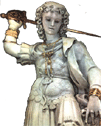
:::Who is like unto God?:::
|
With this seal in this ~MM: Jubilee-Year of our Lord with
his age: IV-years:
For this Ambassador: Glen-Martin: Samaritan of the Troy is founder of
this Christicelli/Christiasselli-Claim of this Catholic-Christian-Church-Community
as many living-cells in one body of our Brother, Redeemer, Lord and Saviour:
Jesus: Christ: King of all Kings in this Kingdom of this Heaven by the
Unity of the Trinity.
:::Thy will be done on Earth,
As, It is in Heaven.:::
|
::::locus-sigilli::::
:::omega::: |