 |
||||||||||||||||||||||||||||||||||||||||||||||||||||||||||||||||||||||||||||||||||||||
|
Site-Search: Home {:Sidebar} |
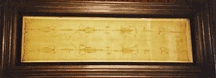
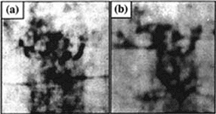
Christ's burial cloth shows signs of the crucifixion and resurrection: |
|||||||||||||||||||||||||||||||||||||||||||||||||||||||||||||||||||||||||||||||||||||



| Report | Dimensions | Mass | Area | Samples | Mass |
| Original film | 478.1 mg | ||||
| Riggi Report no 1, of 26 April 1988 (Rapporto Sindone, page 166) | 7 cm by 1 cm not from the border | 161 mg | 8 cm^2 reduced to 7 cm^2 to remove threads of another nature | 3 (about 50 mg each) | 23 mg /cm^2 |
| Lyon-Matin 8 May 1988, G. Vial | "it was agreed that a strip 8 cm long and 1.5 cm wide" from the border | 12 cm^2 | |||
| Paris-Match for 29 July 1988 (p. 14), J. Évin | Vial and Testore "cut three small strips of cloth, each piece measuring about one by seven centimetres" | 21 cm^2 | |||
| Hall interview by John Cornwell in The Tablet, 14 January 1989 | "the sample was not taken from a border. And, of course, we would have been mad to take it from there. We took it from a part of the Shroud well inside" | ||||
| official report published by Nature, 16 February 1989 (p. 612) | 10 mm by 70 mm | 7 cm^2 | divided into three parts | ||
| Testore Report no 1, of 7 September 1989 (Acts of the Paris Symposium, p. 52 and 68) | 81 mm (warp) by 16 mm (weft) | 300.0 mg (twice that needed: 3 samples of 40 mg each were planned) | 12.96 cm^2 | divided in 5 pieces: first divided in two: 154.9 mg & 144.8 mg, with a loss of 0.3 mg; 154.9 mg piece then divided into three: 52.0 mg, 52.8 mg, & 53.7 mg (which actually adds up to 158.5 mg, for a gain of 3.6 mg) | |
| Riggi Report no 2, of September 1989 (Acts of the Paris Symposium, p. 39 and 41) [changes his earlier data] | 8.1 cm by 1.6 cm; 46% trimmed off to 7 cm by 1 cm (official report in Nature makes no mention of trimming) | 540 mg (text, p. 39) or 497 mg (drawing, p. 41); 300 mg (trimmed); should be 298 mg (based on specific mass); trimmed should be 161 mg | 12.96 cm^2 trimmed to 7 cm^2 | 300 mg piece (note: should be 161 mg) divided into two of 150 mg (text) (note: should be 80.5 mg) or 141 mg (drawing) & 159 mg (calculation) divided into three of 53 mg each (note: should be 27 mg) | |
| Tucson laboratory report | 2 cm^2 (which is about 1/6 of 12.96 cm^2 or about 1/3 of 7 cm^2) | ||||
| Riggi at a conference at the Rosetum in Milan on 28 November 1989 | claims he still has a 141 mg piece | ||||
| Testore’s version no 2, rectification of the 28 October 1989 (Acts of the Paris Symposium, p. 54 and 69) | 144.8 mg divided: 52.0 mg, 52.8 mg, and 39.6 mg (not 53.7) plus14.1 mg taken from the 154.9 mg piece (39.6 + 14.1 mg = 53.7) (50 mg samples needed and not taken from the 154.9 mg piece, except for 14.1 mg) | ||||
| Riggi’s version no. 3 (Petrosillo, p. 129) | 154.9 mg divided: 52.0 mg, 52.8 mg, and 50.1 mg. To 50.1 mg added 3.6 mg from the 144.8 mg piece: 50.1 + 3.6 = 53.7. (why add to a 50.1 mg piece when 40 mg is needed?) | ||||
| Bonnet-Eymard, vol. II, p. 140-150 | Two different and incompatible pieces of cloth seem to be involved. A piece of authentic cloth from the Shroud measuring 8.1 cm by 1 cm was removed in public, seen, and lost since 21 April. These dimensions come from Testore’s report and are confirmed by Vial. #2: A 7 cm x 1 cm strip from another cloth, from which samples were extracted for the laboratories. Everyone has heard about this strip, but no one has seen it. Its dimensions are those of Riggi’s first report and of Tite’s account in Nature | 8.1 cm^2 |
The proof of the substitution lies in:
-
The request for a double of the sample which could take the place of the authentic sample. This attempt failed for the piece taken from Saint Louis d’Anjou’s cope. The same request was made of Ian Wilson. There may have been a second double of the sample.
-
The changes in the various reports by Riggi and Testore.
-
The observation in the official report that the sample reveals no contamination, which is not possible unless the sample comes from another cloth.
-
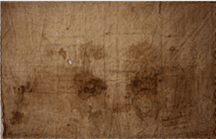
A photograph (published by B. Bonnet-Eymard, vol. II, p. 150) of a part of the sample was delivered to the Tucson laboratory, at 11 times linear enlargement (121 times by area). The sample is abnormally clean, considering that it was photographed before the cleaning process. The weave is the same as that of the Shroud, but it is much lighter in color.
Footnotes:
1 Stevenson and Habermas (1981).
2 Pellicori (1980:1916).
3 Wilson (1978:9).
4 Barbet (1950:23-45).
{:Footer}
:Issues :Solutions :Biofield :Training :Starfire :Catalog :Order
For
all Claims by this Ministry: wizardofeyez are with the Vacancy
of any Claim by any Ministry of this World. For the
Volition of this Ministry is for our Self-Healing of each
Body, Mind and Soul with the Freedom of the Communication
of all Truth by the Authority and Grace of our Sovereign-King
of all Kings of this Kingdom of the Heavens.
:Authorization-© with the Claim of all Rights: U.C.C.~1-207
:SITE-COPYCLAIM-©: 9/8/2001, A.D., with the Freedom against the Egypt-Calendar: G. M. Swartwout©