:Time
"The right timing is in all things the
most
important factor." -Greek poet Hesiod, circa 700, B.C.
"Those that control the past control the
present. Those that control the present control the future."
- 1984 By George Orwell
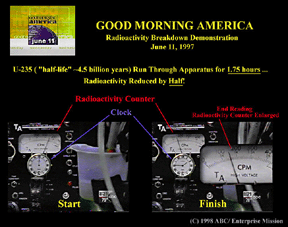
:U-235 Radiation with a half-life
of 4.5 Billion years decreases by 50% in 1.75 hours on Good Morning
America. Radioactive dating is based on presumption of uniformity.
The geological record supports the opposite view of a history punctuated
by catastrophic changes.
Michael Marcum and Dr. David Anderson
(both working on physical time travel hardware) are still missing
and still haven't been heard from.
According to coasttocoastam.com:
"Our initial time travel test with Mr. Noory was successful.
He was able to pinpoint an object we hid two days ago." Coast
To Coast AM has also dealt with time travel with Dr. Bruce Goldberg,
Steven Gibbs, Dr. Fred Bell, Dr. David Anderson, and "Mad Man
Markum."
Why not access time mentally if the brain is like a quantum resonator?
The book The Holographic Universe by Michael Talbot has a section
on time being accessed and manipulated mentally. Targ's research with
Remote Viewing shows that an event like something being hidden can
be accessed before it even happens. Helmut Schmidt and Marilyn Schlitz
demonstrated that after tapes of randomly generated sounds are created
and sealed, people can alter the randomness of the present noise from
the future.
Timing Is Everything
-Ralph Moss, Ph.D., The Moss Reports Newsletter
Imagine a treatment that could
increase the
effectiveness of chemotherapy threefold?that could turn
a suspicious Pap test normal...or determine whether or
not a breast cancer will spread or remain dormant. Such a
"drug" would be worth a fortune to any pharmaceutical
company. Sadly for Big Pharma, this treatment is
not a patentable drug at all, but something we all have
as part of our birthright: time.The idea of using time, or rather
proper timing, to treat illness is called by various names: circadian
rhythm organization, chronobiology or chronotherapy. It
is in fact more than just a treatment; it is a
philosophical perspective that traverses all the realms
of life. The ancient Greek poet Hesiod (c. 700 BC) once
remarked, "The right timing is in all things the most
important factor." In common English, "timing is
everything." The right treatment given at the wrong
time can be ineffective or create a crisis of
escalating toxicity. Conversely, even a weak treatment,
if given at the right moment, might prove surprisingly
effective. The application of this principle to medical
treatment constitutes the emerging field of
chronotherapy.There are over 50,000 articles in PubMed about
chronobiology, nearly 2,000 of which are about cancer.
There are 78 references to clinical trials. Favorable
reviews of the topic have appeared in many of the top
medical journals. Yet, incomprehensibly, the use of
proper timing still remains peripheral to orthodox
oncology. For example, there is no reference to
chronobiology or circadian rhythms in the 164-page
index of the DeVita cancer textbook, the so-called
"Bible of Oncology."In this brief newsletter I can only
skim the surface of
this intriguing subject. My interest in chronobiology
dates back many years, but I was recently reminded of
its importance by two events. The first was a Webcast
of an important seminar on the topic by the National
Cancer Institute's Office of Cancer Complementary and
Alternative Medicine (OCCAM). The second was a speech
by Keith Block, MD, medical and scientific director of
the Block Center for Integrative Cancer Care, in
Evanston, Illinois. I had the pleasure of commenting
on Dr. Block's presentation at the April, 2003
Comprehensive Cancer Care conference in Washington, DC.
Dr. Block is one of the few American physicians who has
incorporated chronotherapy into his own practice.Although much of
the discussion that follows focuses on
cancer chemotherapy, I don't want to convey the
impression that I am necessarily advocating that form
of treatment for any particular kind of cancer. Each
treatment must be taken on its own merits and all
individuals are unique. My point is that the concept
of chronobiology is much larger than any one modality.
As several pioneers in the field recently said, "The
circadian timing of surgery, anticancer drugs,
radiation therapy, and biologic agents can result in
improved toxicity profiles, tumor control, and host
survival." One could probably add that many CAM
treatments would be enhanced by optimal timing, as
well.Chronotherapy in Colorectal Cancer
Francis Levi is one of the great
pioneers of the
chronotherapy concept. A French physician and
researcher at the Hopital Paul Brousse, Villejuif,
France, he has published nearly 150 articles on the
topic, mostly in relation to cancer of the colon and
rectum. In 1999, he and colleagues in Belgium carried
out a randomized controlled trial (RCT) to compare two
treatments for liver metastases from colon cancer. In
each case, the treatment involved high-dose
chemotherapy delivered via hepatic artery infusions
(HAI) as well as the intravenous delivery of the
standard drug 5-FU. The drugs were administered either
at a constant rate (which is a common way that drugs
are delivered) or else according to a chronotherapy
schedule, which involved delivering the drugs at fixed,
predetermined times of the day. Dosage timing was
calculated to coincide with physiological rhythms in
such a way as to maximize the efficacy of the drugs
while minimizing their toxicity.Ninety-two European patients with
metastasized
colorectal cancer were enrolled and randomly assigned
to one or other of the treatments. In this trial, all
treatment was delivered via a special programmable
instrument called the Melodie pump. Drug delivery was
kept constant over a five-day period for about half the
patients, but it was "chronomodulated" for the other half.
The standard drugs 5-FU, as well as an adjuvant drug,
leucovorin, were given at 4 am, while the new European
drug oxaliplatin was given at its optimal time, which
is 4 pm.Severe stomatitis (i.e., mouth sores, a typical side
effect of 5-FU) occurred in five times as many patients
on the traditional schedule compared to those who were
chronomodulated (89% versus 18%). Yet the doses of
5-FU that were administered in the chronomodulated way
were actually higher than those delivered to patients
on the normal schedule.Among the chronomodulated patients, 24 of 45
patients
(53%) had an objective response compared with just 15
of 47 patients (32%) on the usual schedule. The median
overall survival was 19 months for those who received
chronomodulation compared to 14.9 months for those who
received the usual schedule, a significant gain of four
months. The European authors concluded that "this
ambulatory treatment modality was both more effective
and less toxic if drug delivery was chronomodulated
rather than constant over time."In a 1999 article in the journal
Cancer, Dr. Levi
stated that "the objective response rate appeared to be
approximately three-fold as high as that achieved with
current 5-FU-based regimens and translated into an
approximately 50 percent increase in median survival."Levi also
observed that the survival rates of
metastatic colorectal cancer patients were consistently
the longest reported for this disease in multiple
trials. "The chronotherapy concept has played an
important part in the recognition of the activity of
new drugs against colorectal cancer, and has given rise
to a new... strategy with curative potential with
patients with metastatic disease," he stated in a 2001
review in the journal Lancet Oncology.
Enter Dr. Hrushesky
In America, the field of chronobiology
and circadian
organization in medicine has been advanced by the work
of many individuals. I wish to point out two of these.
Prof. Franz Halberg, Director of the Halberg
Chronobiology Center, University of Minnesota, Mayo
Hospital, Minneapolis, was one of the original pioneers
of this concept. He began his investigations of
chronobiology in the 1950s, and has published nearly
500 articles on the topic, an extraordinary record of
scientific achievement.Bill Hrushesky (pronounced Ru-SHES-ki) was
formerly a
professor at the University of Minnesota and is now at
the WJB Dorn VA Medical Center, and the School of
Medicine and Norman J. Arnold School of Public Health
of the University of South Carolina, Columbia. In the
1970s, Hrushesky was at the National Cancer Institute
(NCI), and was involved in the search for new
anticancer drugs. He was studying the use of high-dose
chemotherapy for people who had lung cancer; he also
worked on the first bone marrow transplants. "We were
inducing a lot of damage to human beings with high-dose
chemo," Hrushesky recently said on the NCI Webcast, "We
were seeing deaths" from chemotherapy's toxicity.At this point,
he came across a scientific paper that
changed the direction of his life. The paper had been
published by Dr. Halberg in 1972 in the journal
Science. This article concerned the use of a standard
drug ARA-c, with which Dr. Hrushesky was already very
familiar. Simply by changing the time of day at which
the drug was given to leukemic mice, Prof. Halberg
could increase their survival three-fold. At that time, Dr. Hrushesky
and his NCI colleagues were "kicking drugs up the decision network
tree for a
twenty percent increased life span." Yet here was a
way of increasing survival by 300 percent! It didn't
involve anything other than materials that lay at
hand?just an existing drug combined with good timing.
Hrushesky decided "I'd better pay attention to this,"
and has now spent nearly 30 years doing so. At times
it has been a lonely quest but as he explained to the
NCI conference, he was convinced that there was so
little interest in the topic that if he didn't pay
attention to it, no one else would. He began to explore the many ways
that timing influenced not just cancer treatment but human behavior
in general. Rhythm (or high-frequency chronobiology,
as it is called) is essential to life. The heartbeat is
a rhythm (which, if it malfunctions, can cause illness
or even death). The in-and-out of breathing; the
seasonal drive toward sexual activity in nature; the
menstrual cycle. Everywhere you look in life, even in
plants, you find regularity, waxing and waning,
circadian rhythms .For instance, it is an odd fact that 60 percent
of all
heart attacks occur in the five-hour period of 6 am to
11 am. Hrushesky also uncovered research showing that
cervical smears are more likely to be abnormal at some
times of the year than at others. This could affect
both the screening of whole populations and the
treatment of individuals within that larger group.
Similarly, the efficacy as well as the damaging effects
of chemotherapy turned out to depend in part on the
time of day that the treatment is given.Hrushesky describes this by
unfamiliar terms such as "chronobiotics," "synchronization"
and "tuning", which introduce concepts quite foreign not
just to most
laypeople but to the established way that chemists,
pharmacists and clinicians think about the activity of
drugs. He also points to the central role of the
hormone melatonin, calling it a "primary tuner."
(Melatonin is produced by the pineal gland, a pea-sized
structure that is located deep in the brain.)The effectiveness of
most anticancer drugs depends upon interfering with the synthesis
of new DNA material. It is now well known that there are certain times
of day
in which DNA synthesis is either high or low. In order
to maximize the effectiveness of these drugs it makes
sense to administer them at a time when the synthesis
of genetic material is at its height, since you will
then catch most of the cancer cells with their DNA
unzipped, as it were.
Chronomodulation of Radiation
Radiation therapy also works by
disrupting DNA
synthesis. The skin does much of its regeneration
during the night. Yet the scheduling of radiation
therapy for skin conditions is generally based on
considerations of convenience to the staff and the
patient, rather than timing for maximum effectiveness.
"Treating somebody early in the morning for skin
[disease, ed] will have little effect, positive or
negative," says Hrushesky. "But if the same treatment
were given in late afternoon one might have a
tremendous effect on the tumor because a much larger
proportion [of cancer cells, ed.] were in cell
division." One wonders how many treatments that are
only marginally effective might become far more
worthwhile if delivered at the optimal time.Time of day also influences
the effectiveness of anti-pain medication. It has frequently been
observed
that some patients with skin damage have few symptoms
in the morning but then progress to burning pain by
late afternoon. At night the pain is even more severe.
Yet, curiously, sleep "resets the clock, and the cycle
starts all over again in morning. This pattern, says
Dr. Hrushesky, is almost universal. The answer is to
not administer maximum pain relief on a constant basis,
as is frequently now done, but to base its
administration around the time that the patient
actually experiences the pain most severely, which is
usually in the evening.
Clinical Trials
The notion of chronobiology is
not just pie-in-the-sky
theorizing. It has repeatedly been subjected to
testing in patients, including a number of randomized
controlled trials (RCTs), considered the gold standard
of tests. One of the first such clinical studies in
humans was done with NCI support at the University of
Minnesota. The study, published in the journal Science
in 1984, involved a group of women with advanced
ovarian cancer, all of whom were given the standard
drugs, Adriamycin (doxorubicin) and cisplatin. Half the
patients received treatment at 6 am, the other half at
6 pm. The five-year survival rate was 44 percent in
those who received a favorable timing schedule vs. just
11 percent in those who received a suboptimal schedule.The results
of this study were confirmed in a Phase II
trial by the prestigious Gynecological Oncology Group
(GOG). The GOG trial showed a higher response rate
than expected in endometrial cancer when the treatment
was given at the optimal time of day. Thus, patients
with advanced endometrial cancer were given the drug
Adriamycin at 6 am and their other drug, cisplatin, at
6 pm every 28 days. A review of 30 patients showed 6
(20%) complete responses, 12 (40%) partial responses,
and 7 (23%) with stable disease. Thus there was
clinical benefit in 83% of cases. There were no
treatment-related deaths. The authors concluded that
"circadian-timed delivery of doxorubicin-cisplatin
chemotherapy was reasonably well tolerated and
demonstrated notable response rates in patients with
advanced or recurrent endometrial carcinoma."In a recent review
article, it was shown that chronotherapy could also be used in other
forms of
gynecological and genitourinary cancer as well. For
example, the best time to give Adriamycin (doxorubicin)
for ovarian cancer also seems to be 6 am, while for
cisplatin it is 6 pm. This dosage schedule "enhanced
the control of advanced ovarian cancer while minimizing
side effects?" (Kobayashi 2002). Similarly, the
therapy of metastatic bladder cancer using these same
two common drugs was made more tolerable by the
circadian approach, and resulted in a 57 percent
objective response rate.In a study of patients with metastatic renal
cell
cancer, patients were given their drugs in either a
traditional or a chronotherapy approach. "This study
also confirmed a significant difference in toxicity and
dose intensity, favoring the circadian-modified group."Overall,
the use of timing in cancer therapy appears to
be a logical approach that can greatly decrease the
toxicity of standard treatments, while increasing
effectiveness. Why then hasn't it been widely accepted?The explanation
offered by Dr. Block at the CCC meeting
was that most doctors remain ignorant of this
cutting-edge research, despite years of positive
experiments. New knowledge enters medicine very slowly,
especially when it is not promoted by a major
pharmaceutical company. Chronomodulation also involves
the use of special instruments. At this time Dr. Block
is the only one in the US to utilize the Melodie pump
from France. There also may be a perception that
utilizing a predetermined treatment schedule (often
early in the morning or in the evening) will crimp
oncologists' ability to put considerations of
convenience first in determining the schedule for their
patients' treatment. Chronomodulation also involves a somewhat higher
initial outlay of funds, and thus may be resisted by
insurance companies. However, this is shortsighted.
True, the expense of the timed delivery of medications
is often greater than with the standard approach, not least
because it requires more frequent doctor visits.
However, the outcome of this treatment is often more
effective. As a recent Belgian study noted, "There was
greater tumor response rate and longer time to
progression with less treatment-associated toxicity."Finally,
it was shown that selection of the Melodie
brand infusion pump to deliver the chronotherapy
resulted in "a further 18 percent reduction of overall
costs and made it possible for patients to enjoy
increased autonomy and improved quality of life" (Focan
2002).Chronotherapy seems like another in a long line of good
treatment ideas that remains underdeveloped because it
does not augment the short-term financial interests of
those who provide, or reimburse for, cancer treatment.
--Ralph W. Moss, Ph D
References:
NCI Webcast:
http://videocast.nih.gov/ram/melatonin022803.ram
Halberg's 1972 paper: Haus E., et al. Increased
tolerance of leukemic mice to arabinosyl cytosine given
on schedule adjusted to circadian system. Science 177:
80-82, 1972.
Levi FA, et al. Chronomodulated versus
fixed-infusion-rate delivery of ambulatory chemotherapy
with oxaliplatin, fluorouracil, and folinic acid
(leucovorin) in patients with colorectal cancer
metastases: a randomized multi-institutional trial. J
Natl Cancer Inst 1994 Nov 2;86(21):1608-17
Bertheault-Cvitkovic F, et al. Biweekly intensified
ambulatory chronomodulated chemotherapy with
oxaliplatin, fluorouracil, and leucovorin in patients
with metastatic colorectal cancer. Clin Oncol 1996
Nov;14(11):2950-8.
Levi F, et al. A multicenter evaluation of intensified,
ambulatory, chronomodulated chemotherapy with
oxaliplatin, 5-fluorouracil, and leucovorin as initial
treatment of patients with metastatic colorectal
carcinoma. International Organization for Cancer
Chronotherapy. Cancer 1999 Jun 15;85(12):2532-40.
Levi F. Circadian chronotherapy for human cancers.
Lancet Oncol. 2001 May;2(5):307-15.
Kobayashi M, et al. Circadian chemotherapy for
gynecological and genitourinary cancers. Chronobiol Int
2002 Jan;19(1):237-51.
Barrett RJ, et al. Circadian-timed combination
doxorubicin-cisplatin chemotherapy for advanced
endometrial carcinoma. A phase II study of the
Gynecologic Oncology Group. Am J Clin Oncol. 1993
Dec;16(6):494-6.
Focan C. Pharmaco-economic comparative evaluation of
combination chronotherapy vs. standard chemotherapy for
colorectal cancer. Chronobiol Int. 2002
Jan;19(1):289-97.
