|
||||||||||||||||||||||||||||||||||||||||||||||||||||||||||||||||||||||||||||||||||||||||||||||||||||||||||||||||||||||
|
Site-Search: Home : |
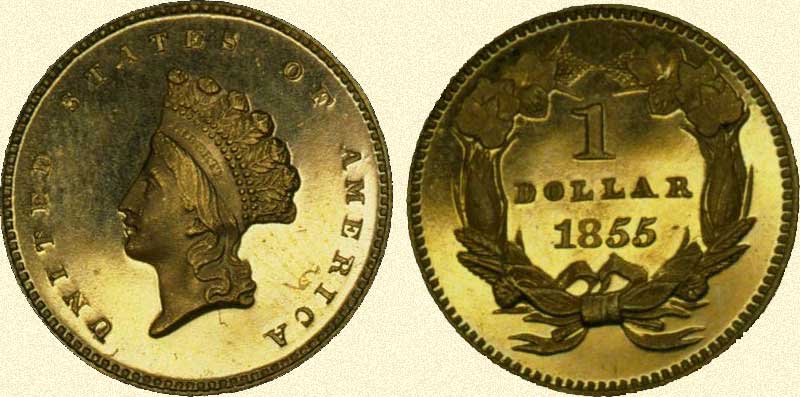
A dollar is defined by the Coinage Act as 371.25 grains of pure silver. Money is defined as gold or silver coin according to the Constitution, Article 1, Section 10. As a weaning or training device, paper silver and gold certificates were circulated as currency before the real money was taken from the people. Gold was confiscated in the 1929 international bankruptcy collection action of 1933, and it was made a felony for U.S. Citizens to own gold coins. Our grandparents didn't know they could become Private and continue to own it lawfully as sovereigns. The new American Republic started in debt to the King of France as he had not only donated 9 million livres (3 million in 1778, 6 million in 1781) for the cost of the tax rebellion but also loaned "eighteen million of livres" between 1778 and 1782 due "1st of January, 1788" and 5 million Dutch florins loaned in 1781 at 4% with payment of 1 million livres per year for ten years "the first of which shall take place in the month of November, 1787, and the last in the same month, 1796", with central payment organized under the Articles of Confederation, ratified 11/17/1777, with "the first year's interest to be paid the 5th of November next [1783], and so yearly during the five years preceding the first term for the payment of the capital, fixed as above on the 5th of November, 1787" at the rate of 1,500,000 livres plus 5% interest annually in 12 payments ending 11/5/1798 according to the 7/16/1782: Contract Between the King and the Thirteen United States of North America. On 2/25/1783, the King granted another loan to help the foundering new nation with "new pecuniary assistance, which he has fixed at the sum of six millions livres tournois, under the title of loan and under the guaranty of the whole thirteen United States [bankruptcy]" with payment of interest on January 1st starting 1785 and principal payments from 1797 to 1802 with the 2/25/1783: Contract Between the King and the Thirteen United States of North America. The Treaty of Paris ended the American tax revolt as part of the world war of 1775-83 involving the States, Great Britain, France, Spain, and the Netherlands. When the States defaults on the note in 1789, after 7 years of bankruptcy to the King of France since his contract of 1782, the King, under increasing revolutionary pressure in France, with the fall of the Bastille on July 14, 1789, sells the note, now beginning a 70 year International Bankruptcy on November 5, 1789, to the Bank of England with the Constitution of the united States of America written as the bankruptcy contract and ratified by the first State: Delaware on 12/7/1787 and last of the 13 States: Vermont on 1/10/1791. When the Constitution gets bogged down in some states, the Bill of Rights (100 years after the Bill of Rights in England) are added to gain acceptance. The President of the united States would eventually be elected on November 5th as Trustee of the Bankruptcy. On April 30, 1789, George Washington, standing on the balcony of Federal Hall on Wall Street (still the real capital-capitol) in New York, took his oath of office as the first President and Trustee of the International Bankruptcy and 15th American President and gives his first inaugural speech. There are three different Presidents of the United States in Congress Assembled prior to the Declaration of Independence:
The French Republic is declared on 9/22/1792. In the war declared 2/1/1793 by the new French Republic against England and the Netherlands, Secretary of State Thomas Jefferson was pro-French, Secretary of the Treasury Alexander Hamilton was pro-British and Washington maintained a neurtral course. Having fought wars, he preferred to be a man of the peace pipe. George Washington's diary shows that he grew Cannabis not only for fiber, but as a medicine: May 12-13 1765: "Sowed Hemp at Muddy hole by Swamp." August 7, 1765: "--began to seperate (sic) the Male from the Female Hemp at Do--rather too late." On 12/30/1796 there is a diplomatic break between France and the US, the beginning of the Quasi War. On 9/30/1800 the Treaty of Mortefontaine between France and the States closes the Quasi War. The Peace of Amiens was signed on 3/25/1802 between France, Spain and Holland on one side and Great Britain on the other, based upon the conditions signed during the London preliminaries of 10/1/1801. 4/30/1803 sees conclusion of an agreement for the cession of Louisiana to the United States, accompanied by two financial agreements; France sells Louisiana (actually owned by the Washitaw Nation) for the sum of 80 millions francs of which 20 million covers French debts to American arms producers who suffered during the Franco-British war. On 11/10/1803 British banker Baring loans the United States the 60 million francs at 6%. In 1823, the interest and capital is fully paid off to the Bank of England by President James Monroe, who announces the Monroe Doctrine claiming American hemispheric sovereignty and control. The national debt was actually paid off twice, first by Thomas Jefferson and then by Andrew Jackson, during the first 70 year international bankruptcy. Back in det by the end of the 70 year term, international bankruptcy was renewed in 1859 and again in 1929 with collection actions known as the Civil War and the Stock Market Crash, or equity transfer, of 1929. The Crash was on . In 1999, collection was made by stealing from trusts and the Unity-States became free for the first time in history, and constitutional governance of the people, by the people and for the people began with the largest budget surplus in history. As an agent of the banking establishment, dubya needed to re-establish the appearance of debt slavery to maintain the slumber of the people's minds. During
Alan Greenspan's chairmanship, the Fed has added $5 trillion to the
supply of dollars and may add When a study was made of how much
the federal government is now likely to need to pay for all its promises,
reduced by what it is likely to collect in taxes, the shortfall comes
to $44 trillion or about half a million dollars per family. That doesn't
count the private debt in America, estimated to be another quarter
of a million per family. Then there is also the trade deficit, currently
adding up at about $500 billion annually. At the end of 2003, the
Federal Reserve system's Required Reserves are $41.64 billion while
Savings and other Deposits are $4084.8 billion (or Total Assets of
the U.S. banking system of $4,381 billion) for a fractional reserve
banking reserve ratio of just 0.01, or one cent on each dollar, not
the 10¢ we are taught in textbooks. This is made possible by
a technology that Greenspan and Bernanke have at their command called
a printing press to aid in committing monetary fraud on a grand scale.
When Peter Drucker was asked by Fortune magazine what weakness he
sees in the American economy, he said, "Never before has a major
debtor country owed its debt in its own currency. It is unprecedented
in economic history. Japan, by contrast, owes all its foreign debt
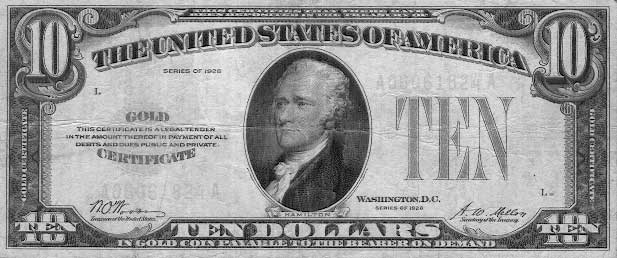
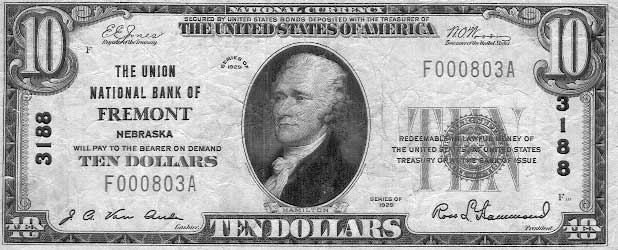
in dollars. Now if you devalue the Here is a gold certificate contract that the so-called government will no longer honor even thought the Constitution guarantees that no law can impair the rights and obligations of contract. In other words our grandparents got screwed, and things are only getting worse...
There is a critical difference between U.S. coins and Federal Reserve Notes (F.R.N.s, or F.R.A.U.D.s: Federal Reserve Accounting Unit Devices) as shown in the Annual Report of any Federal Reserve Bank, e.g. San Francisco: http://www.frbsf.org/publications/federalreserve/annual/index.html The Financial Statements show this clearly at: http://www.frbsf.org/publications/federalreserve/annual/2001/ar01-7.pdf The
list of assets and liabilities on page 4 of this file (page 43 of
the report) shows $144 million in coin as an asset, $1.1 billion in
gold certificates, and $56.6 Billion in U.S. government and federal
agency securities.
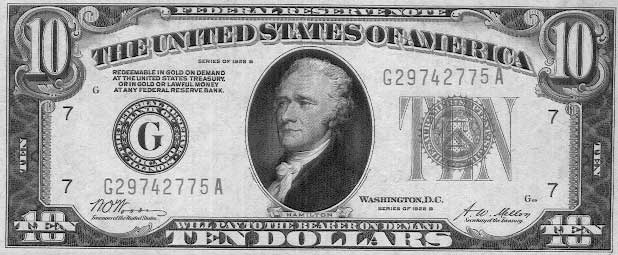
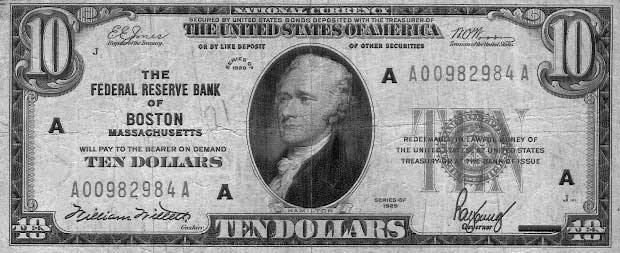
Above is an early Federal Reserve Note redeemable in lawful money (silver or gold coin). Below are a Federal Reserve Bank Note and a National Bank Note secured by debt but still redeemable in lawful money. Try asking a bank today to redeem your debt notes in lawful money...
What are: F.R.A.U.D.s? As a liability, the bank lists $49.3 billion in Federal Reserve Notes outstanding. Any "12/L" note in your wallet is just a small piece of this debt to you (a promisory note: promising to pay at no specified time in the future, which will never arrive, as it is always now), which is backed by an even greater debt of $56.6 Billion owed to the bank by the Federal government, which is owed by you if you are still under contract as a member of the public (debtors), rather than the private sector (creditors). This means that there is never enough F.R.A.U.D.s created to actually pay off the Federal debt, resulting in debt slavery of the government to the banks. In contrast, coin is listed as an asset on equal footing to the debt owed the bank by the federal government, but the coin is interest-free. The Federal Reserve banks have to buy coins from the U.S. Mint at full face value, which credits 89 cents per one dollar coin in seniorage (profit) to the Treasury. In its first year of issue, the new dollar coin reduced the Federal debt by $700 million in this way. Similarly, on the next page, the income statement for the bank includes $3 billion in interest on the U.S. government and federal agency securities, but no interest on their coin assets. The San Francisco Federal Reserve Bank collected $3 billion in interest from the Federal government's debt to it, but only paid $2.67 billion back to the Treasury as interest on F.R.N.s. They keep the hundreds of millions of dollars difference as profit each year, as do the other semi-private regional banks. There has been no public audit of this system in 90 years. Currently the Federal budget deficit is increasing at a rate of nearly $12 per household per day. If each household exchanged (retired) $14 in F.R.A.U.D.'s for $14 in Sacagawea coins at the bank each day and spent them into circulation, this would just hold the line on the deficit. Federal Reserve Notes issued must be backed by valuable commodities, stocks, land, securities or other assets of the bank. U.S. government and federal agency securities (i.e. federal indebtedness to the bank) are treated as assets for this purpose. Here is what happens:
Essentially, the Federal government securities are a loan from the bank to the Federal government (created by the stroke of a key), on which they pay $3.0 billion per year in interest just to the regional bank in San Franscisco, and the Federal Reserve Notes are bought by the bank for a penny on the dollar based on that transaction as an asset of the bank. It is the largest financial scam in the history of the world.
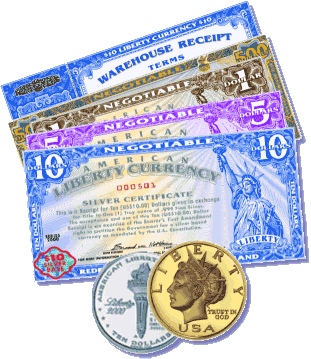
Value of a Dollar: The government currently produces two coins with the same face value of $1.00. There is also a new private currency dedicated to eliminating the I.R.S. and the Federal-Reserve banksters. The wizard wonders: which specie is worth more? Which one is a better value? What kind of bang are you getting for your hard earned buck? The kind you need like you need a hole in the head, especially if you wake up one morning and the dollar just moved south about as far as Argentina where they aer trading in grain and gold because the money has lost its savor...
How much debt will you
have retired in the next 20 years? Robert Stift, counselor for the
Constitutional Patriots Association, has researched the national debt
and sent us these interesting observations: Notes for the Calculation of the Sacagawea-Dollar-Value: If you think your grandparents' gold is still in Fort Knox...the government that sole it from them has a new 'gold' coin to sell you. It is made of Copper, Zinc, Manganese and Nickel and it is worth about a penny. That ratio of value also represents the amount of value in a dollar that has already been extracted from the American people by the international "Federal Reserve" semi-private, never audited bankers over the last 90 years. And I bet you didn't even get a Christmas card from Allen Greenspan, David Rockefeller, or any of the crooks...even their corporate sales Executives down in Washington, Distric of Criminals... Here's how we figure out the value of the metal in the new golden 'Saca-something' trinket: Cu, Zn: http://www.coppernews.com Price per gram of each metal component: Cu: 67.15 cents/lb = 453.59g
= 0.14804 cents/g (1 pound = 453.59 grams) Market value of each metal component of the coin: 7.1685g Cu = 1.06122 cents Total-metal-value of the Sacagawea-dollar-coin: 1.19159 cents
|
|||||||||||||||||||||||||||||||||||||||||||||||||||||||||||||||||||||||||||||||||||||||||||||||||||||||||||||||||||||
|
: :Issues :Solutions :Biofield :Training :Starfire :Catalog :Order For
all Claims by this Ministry: wizardofeyez are with the Vacancy
of any Claim by any Ministry of this World. For the
Volition of this Ministry is for our Self-Healing of each
Body, Mind and Soul with the Freedom of the Communication
of all Truth by the Authority and Grace of our Sovereign-King
of all Kings of this Kingdom of the Heavens. :SITE-COPYCLAIM-©: 9/8/2001, A.D., with the Freedom against the Egypt-Calendar: G. M. Swartwout© |
||||||||||||||||||||||||||||||||||||||||||||||||||||||||||||||||||||||||||||||||||||||||||||||||||||||||||||||||||||||